Quick Answer: Dubai has become the leading gateway for global commodity trading in the Middle East because of its strategic geographic position between Europe, Asia, and Africa, its free zone infrastructure with zero corporate tax on qualifying trade, world-class port and airport logistics through Jebel Ali and DP World, deep trade finance and banking access, and regulatory frameworks built specifically to support re-export for commodities including agro products, frozen meat, energy, and minerals.
A commodity trading hub is a location where buyers, sellers, financiers, and logistics providers concentrate to make cross-border trade faster, cheaper, and lower-risk than transacting directly between origin and destination countries. Historically, cities like London, Geneva, and Singapore held this role for global commodities, each one built around a specific combination of banking depth, legal certainty, and port access that made it easier to trade through that city than around it.
Over the past two decades, Dubai has built the same function for trade flowing between the Middle East, Africa, South Asia, and Central Asia. It did not happen by accident. The UAE government made a deliberate, sustained policy decision to position Dubai as a trade and logistics center rather than rely solely on oil revenue, and commodity trading infrastructure was one of the earliest and most consistent areas of that investment.
The core ingredients that create a trading hub are consistent worldwide: efficient ports, trusted banking and trade finance infrastructure, transparent legal frameworks for contract enforcement, and a concentration of trading companies that buyers and sellers already trust to work with. Dubai has built all four deliberately, and the result is that a growing share of commodity trading Dubai activity is not commodities originating in or destined for the UAE itself. It is commodities passing through Dubai as the trading and logistics point between two other regions entirely.
Several Gulf cities have made investments in trade and logistics infrastructure over the same period, yet Dubai has consistently pulled ahead as the region's primary commodity trading center. Understanding why requires looking at four specific advantages that compound together rather than functioning in isolation.
Dubai sits within an eight-hour flight of two-thirds of the world's population. For commodity trade specifically, this means a single Dubai-based sourcing office can realistically coordinate shipments moving between European and South American origins and buyers across the Middle East, East Africa, South Asia, and Central Asia without the time zone and travel friction that would exist if that same office were based in a different region entirely.
This geographic centrality also means Dubai functions as a natural midpoint for physical goods, not just information and finance. A container moving from a South American port toward a buyer in East Africa can realistically transit through or be consolidated in Dubai without adding meaningful distance to the overall journey, which is not true of every candidate hub city in the region.
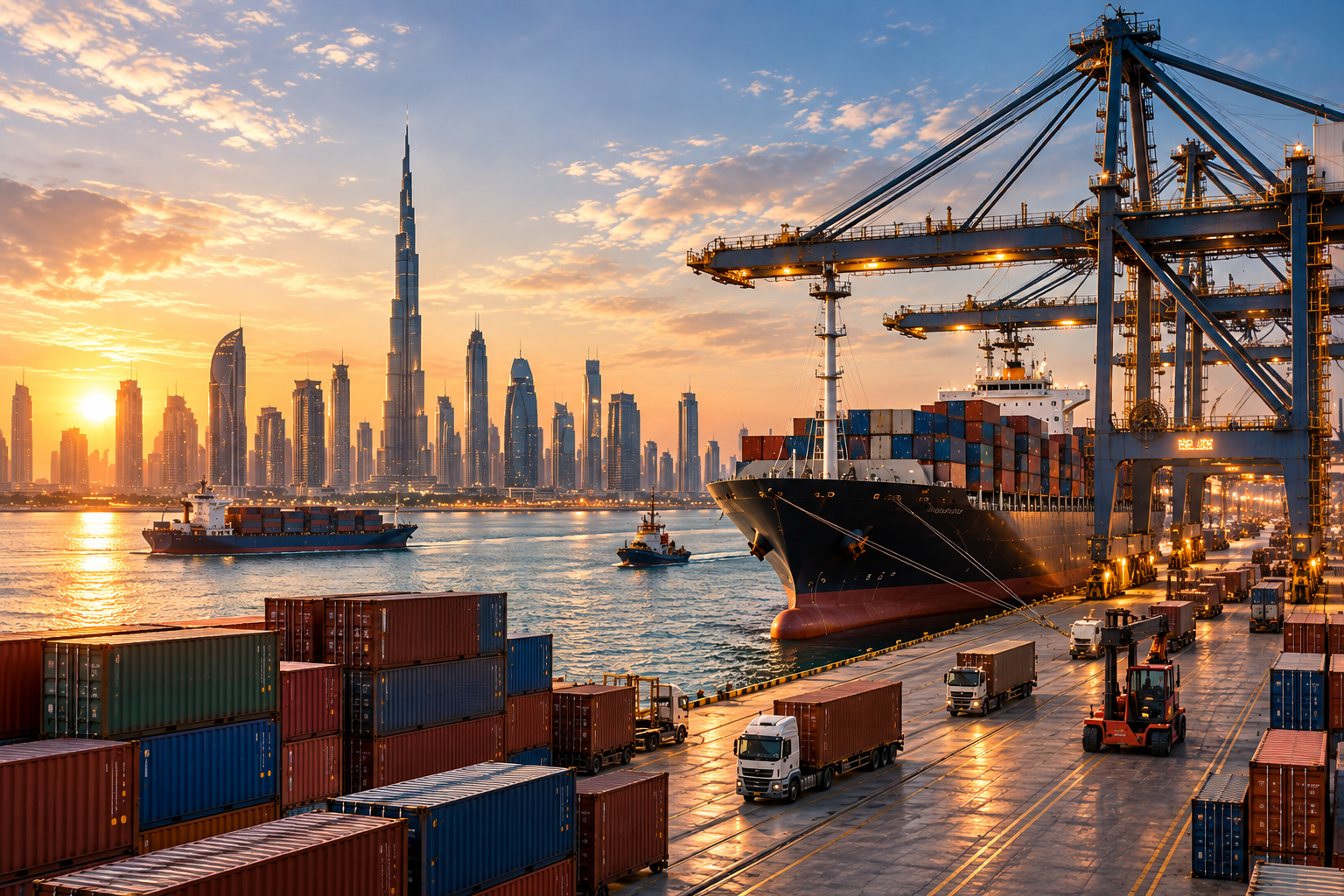
Jebel Ali Port, operated through DP World, is one of the largest and most efficient container ports in the world and the primary maritime gateway for goods entering and re-exporting through the UAE. This infrastructure matters directly for global sourcing company Dubai operations because it means container transit times, port handling reliability, and cold chain capability for frozen and perishable commodities meet a consistent international standard that many other regional ports cannot match.
Beyond the physical port itself, Dubai has built an integrated logistics ecosystem around it, including dedicated free zones for logistics and distribution, bonded warehousing facilities that allow goods to be stored and re-exported without incurring import duties, and cold storage capacity purpose-built for frozen and IQF food products moving through the region. This combination of port capacity and surrounding logistics infrastructure is what allows Dubai to function as a genuine distribution point rather than simply a transit stop.
The UAE's free zone system allows qualifying trading companies to operate with 100 percent foreign ownership and favorable tax treatment on qualifying income. For a commodity trading company moving product between two other countries without either being the UAE, this structure materially reduces the cost of doing business compared to structuring the same trade through a jurisdiction without equivalent free zone provisions.
This matters more for commodity trading than for many other industries because margins in bulk commodity trade are often thin relative to transaction size, and even small structural cost advantages compound significantly across high-volume trading operations. A trading company moving several container loads of agro commodities or frozen meat per month accumulates meaningful savings from operating through a well-structured free zone entity compared to a jurisdiction with less favorable tax treatment on that trade flow.
International banks with strong commodity trade finance desks maintain a significant presence in Dubai, providing Letters of Credit, trade guarantees, and financing structures that commodity buyers and sellers depend on for large transactions. Access to reliable, internationally recognized trade finance is one of the least visible but most important reasons serious commodity trading companies choose to base or route transactions through the Dubai trade hub rather than negotiate financing separately in each origin or destination market.
For buyers in markets where local banking infrastructure has less depth in international trade finance, working with a Dubai-based trading partner often means the difference between a transaction that can be structured with a bank-backed Letter of Credit and one that has to rely on less secure payment arrangements that expose either the buyer or the supplier to unnecessary risk.
Dubai's role as a trading hub spans multiple commodity categories rather than a single specialization, which is itself part of why it has become so central to Middle East trade rather than being known for one narrow product niche.
Precious metals and minerals. Dubai has one of the largest gold trading markets in the world, supported by the Dubai Multi Commodities Centre and a dense network of refiners, assayers, and trading houses. Gold, along with diamonds, gemstones, and industrial minerals like copper and aluminum, moves through Dubai in significant volume both for regional consumption and re-export toward markets across South Asia and Africa.
Energy products. Diesel, jet fuel, crude oil, and other petrol products are actively traded through UAE-based companies serving buyers across the Gulf, East Africa, and South Asia, supported by the region's own refining capacity and its position along major shipping lanes connecting the Persian Gulf to the Indian Ocean and beyond.
Agro commodities. Wheat, sugar, rice, and vegetable oils move through Dubai-based trading companies as part of supply chains feeding food security needs across the wider Gulf and East African region, where domestic agricultural production cannot meet local demand due to climate and water availability constraints that are not going to change.
Frozen meat and IQF produce. Dubai's cold chain and re-export infrastructure supports frozen chicken, beef, and IQF fruit and vegetable trade moving from origin countries in South America, Europe, and Asia toward destination markets across the GCC and East Africa, where growing populations and expanding food service sectors continue to push import demand upward year over year.
For a buyer in Iraq, Ghana, or elsewhere in the Middle East and Africa, working with a sourcing partner that operates through Dubai often means faster access to trade finance, more consistent documentation standards, and shorter transit times than sourcing directly from a supplier based only in the country of origin. This is a large part of why global sourcing company Dubai relationships have become a practical advantage rather than just a geographic convenience for buyers across the wider region.
There is also a risk management dimension worth understanding. A buyer sourcing exclusively through a single origin-country supplier is exposed to that country's specific export regulations, banking limitations, and political risk with no intermediary layer of protection. A buyer working through a Dubai-based trading partner benefits from the UAE's stable legal and financial framework acting as a buffer, even when the underlying commodity is produced somewhere else entirely. This is one of the underappreciated reasons experienced procurement teams across Iraq and West Africa increasingly prefer to route sourcing relationships through partners with a genuine Dubai presence rather than dealing directly and exclusively with origin-country suppliers.
ARCOSAL, Allied Resourcing Company Offshore S.A.L., works across the same commodity categories that move through Dubai's trading infrastructure, including agro commodities, frozen meat, IQF fruits and vegetables, petroleum products, and minerals. As we expand our sourcing and supply chain services to buyers across Iraq, the UAE, Ghana, and the wider West African market, our approach follows the same principle that has made Dubai central to regional trade: direct relationships with certified processing facilities and origins, complete documentation prepared before shipment rather than after, and trade finance structures that protect both buyer and supplier throughout the transaction.
You can read more about how we structure sourcing and supply chain solutions for buyers across these regions on our Sourcing and Supply Chain page.
Whether you are sourcing bulk agro commodities, frozen and IQF food products, or energy and mineral products for markets across the Middle East and Africa, ARCOSAL's global network is built to move your commodities as efficiently as the trading infrastructure Dubai has spent two decades developing.
Contact the ARCOSAL team at Info@arcosalbe.com or visit arcosalbe.com to discuss your sourcing requirements across Iraq, the UAE, Ghana, and West Africa.