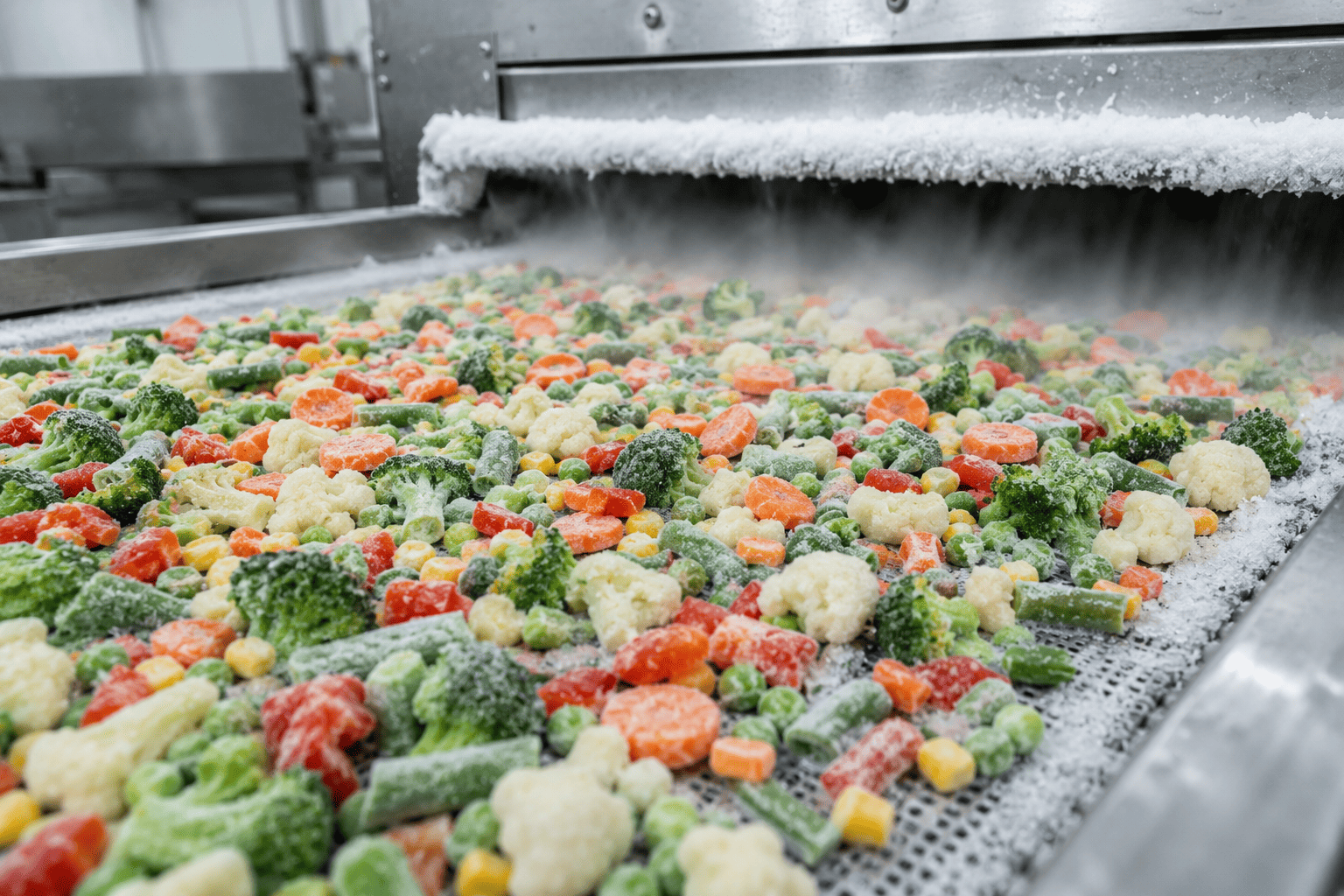
If you source frozen fruits or vegetables for food manufacturing, beverage production, or retail distribution, you have almost certainly come across the term IQF without necessarily knowing exactly what separates it from conventional freezing methods and why that difference matters commercially. Understanding what IQF freezing is and how it compares to block freezing is not just a technical detail. It directly affects the quality of the product you are buying, the yield you get after processing, and ultimately the value your customers receive.
This guide explains IQF freezing in plain terms, walks through why it produces a superior product compared to block freezing, and covers what food manufacturers and distributors should know before sourcing frozen produce at scale.
IQF stands for Individually Quick Frozen. The name describes exactly what the process does. Each individual piece of fruit or vegetable is frozen separately and rapidly before being packaged, rather than being frozen together in a mass or block.
In a standard IQF food manufacturing operation, fresh produce is cleaned, sorted, and graded before passing through a freezing tunnel or drum where extremely cold air circulates around each individual piece at high speed. The freezing happens fast enough that ice crystals forming inside the cellular structure of the fruit or vegetable remain very small. Small ice crystals cause minimal damage to cell walls. Minimal cell wall damage means the product retains its shape, texture, colour, and nutritional profile in a way that slower freezing methods simply cannot achieve.
The end result is a bag of strawberries, green peas, or spinach where each piece is separate, free-flowing, and structurally intact. When you open the bag you can take out exactly the quantity you need and return the rest to storage without the product clumping, degrading, or losing quality. This is what makes IQF freezing the preferred method for professional food manufacturing applications worldwide.
To understand why IQF vs block frozen is such an important distinction for buyers, it helps to understand what block freezing actually involves. In block freezing, product is placed into trays or containers in bulk and frozen as a single mass. The freezing process is slower because the cold needs to penetrate through the entire block rather than surrounding each individual piece. Slower freezing means larger ice crystals form inside the product cells, which ruptures cell walls and causes structural breakdown.
When a block frozen product is thawed, the damage caused by those larger ice crystals becomes visible immediately. The product releases excess liquid, loses its original texture, turns soft or mushy, and in the case of fruits, can lose a significant portion of its colour and flavour. For a food manufacturer processing this product into a finished product, that means lower yield, inconsistent quality, and more waste per kilogram purchased.
Block freezing is not without its place in food manufacturing. For applications where the product will be cooked down, blended, or heavily processed anyway, the texture degradation is less relevant and block frozen products can be the more cost-effective choice. But for applications where the integrity of the individual piece matters to the end product, IQF freezing consistently delivers a better result.
The reason IQF food manufacturing has become the standard for premium frozen produce supply comes down to three practical advantages that affect the bottom line directly.
The first is yield. Because IQF frozen product retains its cellular structure through the freezing process, the drip loss after thawing is significantly lower than with block frozen product. For a manufacturer buying product by the kilogram, lower drip loss means more usable product per unit of spend. Over a full year of purchasing volume, that difference in yield is commercially meaningful.
The second is portion control and process efficiency. In a food manufacturing environment, being able to measure exact portions of free-flowing IQF frozen product without thawing an entire block is a significant operational advantage. It reduces waste, speeds up production lines, and makes quality control easier because each piece is consistent in size and weight.
The third is the quality of the finished product. Whether the application is a premium yogurt with visible fruit pieces, a ready meal with whole vegetable components, a smoothie brand that photographs its ingredients, or a bakery product where fruit pieces need to hold their shape during baking, IQF freezing produces a raw ingredient that performs better in the finished product than block frozen equivalents. This matters most in categories where the appearance and texture of the end product is part of what the consumer is paying for.
One of the reasons IQF freezing has become the method of choice for premium food supply chains is its relationship with nutritional retention. Because the freezing process happens rapidly and the product is frozen at peak freshness immediately after harvest and processing, the nutritional profile of an IQF frozen fruit or vegetable is often comparable to and in some cases better than fresh produce that has spent multiple days in transport and ambient storage before reaching a processing facility.
This is particularly relevant for buyers supplying health-conscious food brands, organic product ranges, or nutritional supplement manufacturers where the integrity of the raw ingredient is central to the product proposition. Sourcing IQF frozen produce rather than block frozen or out-of-season fresh can actually strengthen the nutritional story your brand tells.
Understanding what IQF freezing is is one thing. Knowing what to look for when you are sourcing IQF frozen fruits and vegetables from an international supplier is another matter entirely.
The quality of IQF frozen products varies depending on the quality of the raw produce that went into the freezer, the capability of the processing facility, and how the cold chain has been managed from production through to your receiving dock. Premium IQF food manufacturing starts with produce harvested at the right stage of ripeness and processed quickly before quality begins to decline. Facilities with modern high-speed freezing equipment produce better free-flow and lower drip loss than older installations running slower tunnels.
Glazing is a specification worth confirming before placing any order. Glazing refers to a light coating of ice applied to the surface of IQF frozen product after freezing to protect it during storage and transport. A reasonable glazing percentage is normal and expected. An excessive glazing percentage means you are paying for water weight rather than product weight, which directly reduces the value of what you are buying. Always confirm the maximum glazing percentage in writing before committing to an order.
Storage and transit temperature compliance is equally important. IQF frozen produce should be maintained at minus 18 degrees Celsius or below throughout the entire supply chain. Any variation above this temperature, even briefly, can cause partial thawing and refreezing that degrades the free-flow quality and the texture of the product in ways that are difficult to detect before the product reaches your facility.
At ARCOSAL, IQF frozen fruits and vegetables are one of our core product categories. We source directly from certified processing facilities across Eastern Europe, North Africa, Central Asia, and Southeast Asia, supplying food manufacturers, beverage producers, wholesalers, and retail distributors across Europe, the Middle East, and beyond.
Our IQF range covers strawberries, blueberries, raspberries, blackberries, sour cherry, apricot halves, spinach, diced onions, diced garlic, okra in whole and cut formats, green peas, and sweet corn kernels, alongside juice concentrates, purees, and canned foods. Every product is sourced with full traceability, cold chain documentation, and product specification confirmation before shipment.
We handle origin selection, supplier vetting, quality checks, documentation, and logistics so that our buyers receive exactly what they ordered, at the agreed specification, with the shelf life and cold chain integrity their business depends on.
If you are looking for a trusted source of IQF frozen fruits and vegetables for your manufacturing or distribution operation, we are ready to discuss your requirements.
Contact the ARCOSAL team at Info@arcosalbe.com or visit arcosalbe.com to explore our full IQF and frozen food sourcing capabilities.