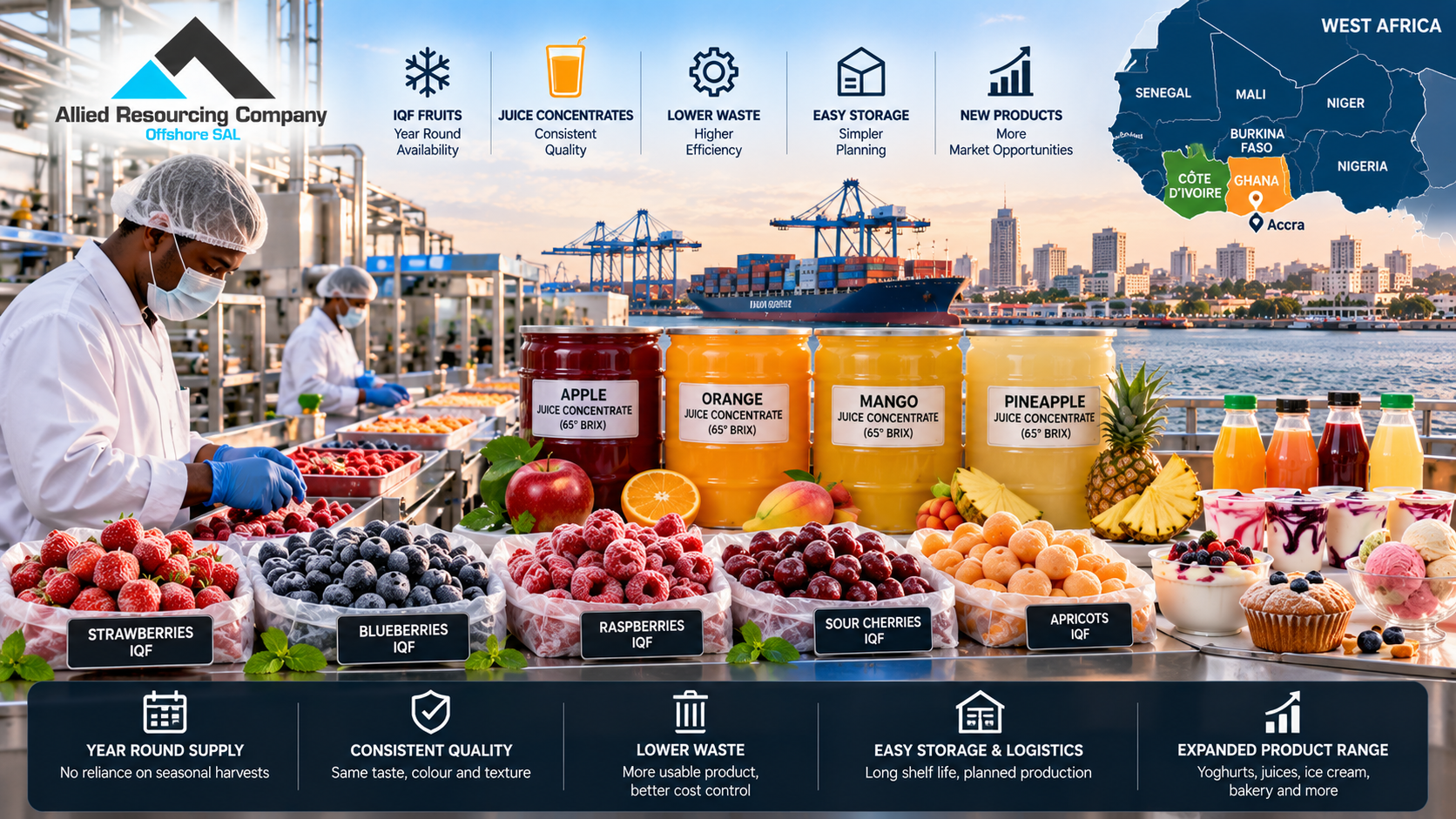
A juice factory in Accra runs well for three months of the year. During mango and pineapple season, fresh fruit arrives by the truckload, the lines run at capacity, and the product tastes excellent. Then the season ends. Fruit becomes scarce and expensive, quality varies from one delivery to the next, and the factory either slows down or pays premium prices to keep running. Meanwhile a competitor across town runs at steady output all year, with the same taste in January as in July.
The difference is often not the recipe. It is the raw material strategy. The competitor blends local fresh fruit with imported juice concentrates and IQF fruit, using each where it makes the most sense.
This shift is happening across West Africa’s food and beverage sector. This article looks at the five main reasons behind it, who is making the switch, and how a processor can start.
West Africa grows excellent fruit. Mangoes, pineapples, oranges, papayas and many other crops thrive in the region. But fresh fruit is seasonal, and processing plants built around a single harvest window spend much of the year underused.
IQF fruit and juice concentrates break that link. Because they are frozen or concentrated at the peak of harvest in their origin countries, they can be stored and used whenever production needs them. A processor can run a strawberry yoghurt line in March, a mango drink in October and a mixed berry smoothie in December, without waiting for any local harvest.
This does not replace local fruit. The smartest processors use fresh local fruit when it is in season and at its best, and rely on IQF and concentrates to fill the gaps and supply fruits that do not grow locally.
Supermarkets, distributors and consumers expect a branded product to taste the same every time. With fresh fruit, that is hard. Sweetness, acidity, colour and ripeness change from farm to farm and week to week.
Juice concentrates are traded to defined specifications. A concentrate is described by its Brix level, which measures soluble solids and is closely linked to sweetness, alongside its acidity, colour and other parameters. A beverage manufacturer that reconstitutes concentrate to a set Brix gets a far more predictable result than one squeezing whatever fruit arrived that morning.
IQF fruit offers similar control. Pieces are graded for size, colour and defects before freezing, so each carton performs much like the last.
Fresh fruit losses are a serious problem in many parts of the world, and West Africa’s heat, transport distances and limited cold storage make them especially costly. Fruit bruises, ripens too fast, or spoils before it reaches the factory. Even inside the plant, peeling, coring and sorting generate waste.
IQF fruit arrives cleaned, prepared and ready to use. There is no peeling, no coring, no rejects on the line. Juice concentrate removes most of the water before shipping, which means far less volume and weight to transport and store for the same amount of fruit.
When processors compare cost per usable kilo rather than price per kilo, IQF and concentrates often compete well with fresh fruit, especially outside the local season.
Fresh fruit needs to be used within days. IQF fruit, stored at -18°C or colder, keeps its quality for many months. Concentrates, depending on type, are stored frozen or in aseptic packaging, and also have long storage lives when handled correctly.
That changes how a factory plans. Instead of reacting to daily fruit deliveries, a processor can buy in container loads, store stock, and draw down according to the production plan. Purchasing becomes a planned activity rather than a daily scramble.
Because concentrate is so compact, a single container can carry the fruit equivalent of many truckloads of fresh produce. Freight, handling and storage costs per unit of finished product fall accordingly.
Consumer tastes in West Africa are evolving. Growing urban populations in Accra, Kumasi, Lagos, Abidjan and Dakar are buying more yoghurts, flavoured drinks, ice creams, bakery products and ready-to-drink beverages. Many of these products call for fruits that are not grown locally, such as strawberries, blueberries, raspberries and cherries.
IQF fruit makes those products possible. A dairy in Ghana can launch a strawberry yoghurt without importing fresh strawberries by air. A bakery can add blueberry muffins to its range. A juice brand can introduce apple or berry blends alongside its tropical flavours.
Processors with consistent, export-quality products are also better placed to sell into neighbouring markets across ECOWAS.
|
Area |
Fresh Fruit Only |
With IQF Fruit and Concentrates |
|
Production calendar |
Tied to local harvest |
Year round |
|
Flavour consistency |
Varies with each delivery |
Controlled by specification |
|
Waste |
High from spoilage and preparation |
Minimal |
|
Storage |
Days |
Months |
|
Product range |
Limited to local fruits |
Includes berries, cherries, apple and more |
|
Purchasing |
Daily, reactive |
Planned, container based |
For processors new to concentrating, a few basics help.
What it is. Juice concentrate is fruit juice with most of its water removed, usually by evaporation. The factory adds water back to reconstitute the juice to the required strength.
Brix. The key measurement. Concentrates are traded at defined Brix levels, and the manufacturer reconstitutes a target single strength Brix for the finished drink.
Common types. Apple, orange, mango, pineapple, grape and berry concentrates are among the most widely used. Mango and pineapple purees and concentrates are also widely traded.
Clear or cloudy. Some concentrates are clarified, others retain pulp or cloud. The choice depends on the finished product.
Packaging. Concentrates are commonly supplied in drums, often aseptic or frozen depending on the product, and in larger bulk formats for high volume users.
What it is. Fruit that is washed, sorted, prepared and frozen quickly so that each piece freezes separately. Pieces stay free flowing and can be measured out as needed.
Common types for processors. Strawberries, blueberries, raspberries, blackberries, sour cherries and apricot halves, among others.
Typical uses. Yoghurt and dairy fruit preparations, ice cream, bakery fillings, jams, smoothies and desserts.
Formats. Whole, sliced, diced or crumble, in cartons or large bags suited to industrial use.
See the full range ARCOSAL sources on our IQF fruits, vegetables and canned food page.
“Our customers want natural products.” IQF fruit is simply fruit that has been frozen, with nothing added unless the specification calls for it. Reconstituted juice from concentrate is fruit juice with its water restored. Labelling should describe the product accurately, but neither ingredient is artificial.
“We do not have enough freezer space.” Many processors start by using a third party cold store near the port or factory and drawing stock weekly. Concentrates take far less space than the equivalent fresh fruit, which helps.
“Imports will cost us foreign currency.” That is true, and currency planning matters. But the comparison should include the cost of idle production lines, spoiled fresh fruit and lost sales during the off season. For many processors, the combined approach improves total margins even after currency costs.
“Quality from abroad is unpredictable.” Only if it is bought without a specification. Concentrates and IQF fruit traded on clear parameters, checked by independent inspection and supported by certificates of analysis are often more predictable than local fresh supply.
ARCOSAL sources IQF fruits, IQF vegetables, juice concentrates and canned foods from qualified processors in multiple origins and supplies food and beverage manufacturers across Africa and the Middle East. We help processors define specifications, select the right products, verify quality before loading and manage cold chain logistics to West African ports. Explore our IQF and canned food range or visit arcosalbe.com to start the conversation.
IQF fruit gives year round availability, consistent quality, minimal waste and long storage life. It also lets processors make products with fruits that are not grown locally, such as strawberries and blueberries.
Juice concentrate is fruit juice with most of its water removed. Manufacturers add water back to reconstitute it to the required strength for their finished drinks.
Brix measures the soluble solids content, mostly sugars, in a juice or concentrate. Concentrates are traded at defined Brix levels, and manufacturers reconstitute a target Brix.
No. Many processors use local fresh fruit when it is in season and use concentrates and IQF fruit to fill gaps and add fruits that are not available locally.
At -18°C or colder, from arrival through to use, without thawing and refreezing.
Strawberries, blueberries, raspberries, blackberries, sour cherries and apricot halves are among the most widely used in dairy, ice cream, bakery and beverage production.
The Food and Drugs Authority regulates food imports in Ghana, including permits and product registration. Confirm current requirements with your clearing agent.
Map annual demand, define specifications, test samples in production, confirm cold storage, check regulatory requirements and start with one or two products before scaling up.