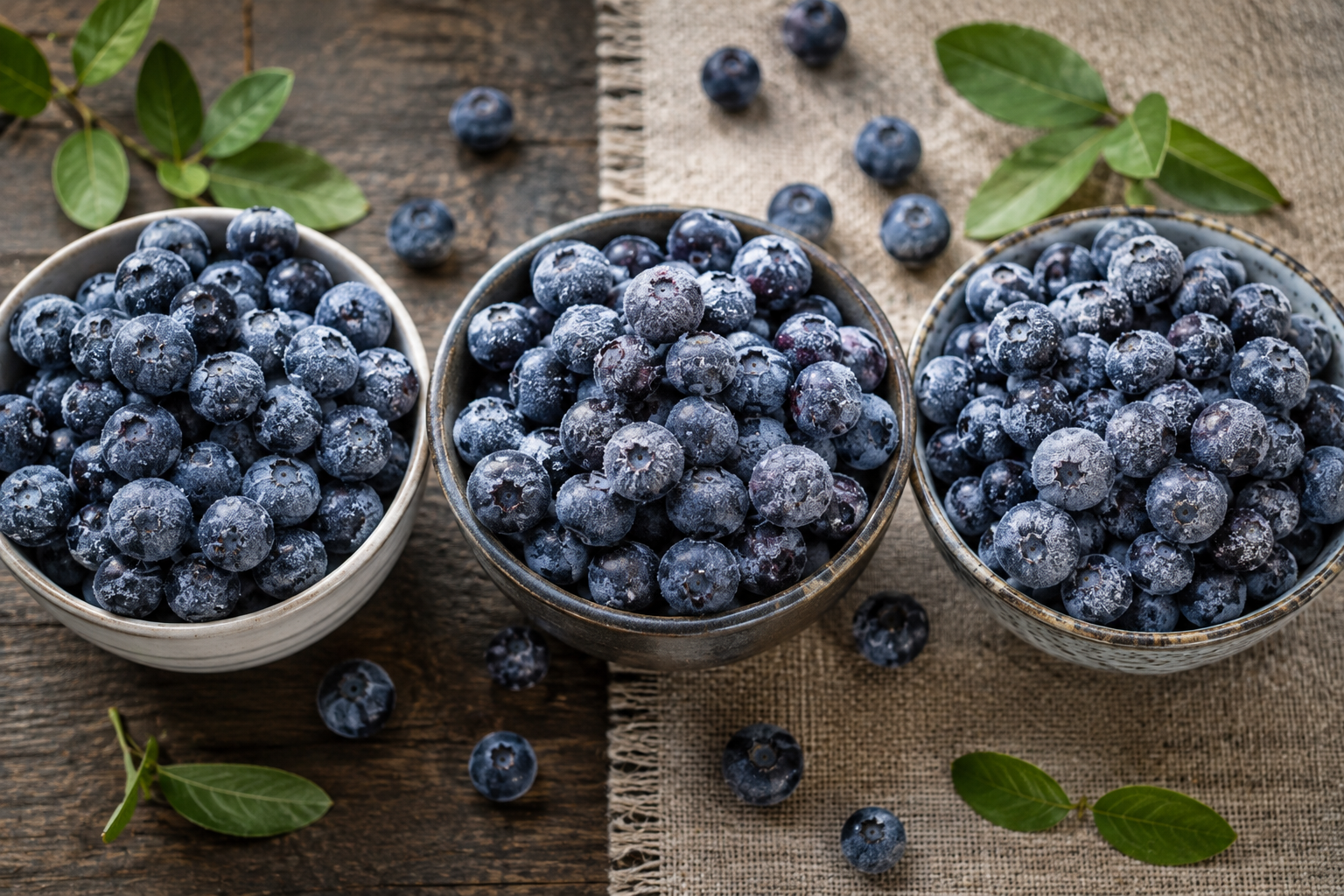
Blueberries have become one of the most actively sourced products in the global IQF blueberries market over the past decade, and the buyers driving that demand are not retail consumers browsing supermarket freezer aisles. They are food manufacturers, beverage producers, yogurt brands, smoothie companies, and bakery operations who need consistent volume, reliable specifications, and year-round supply from origins they can depend on. The challenge with frozen blueberries bulk sourcing is that blueberries are seasonal by nature, the quality profile varies significantly between origins, and the pricing dynamics shift depending on which hemisphere is in harvest at any given point in the year.
Getting origin selection right when sourcing IQF blueberries is not a secondary consideration. It directly affects your cost per kilogram, your product quality, and your ability to maintain supply continuity across a full production year. This guide compares the three origins that matter most to buyers in this category.
Most IQF fruits can be sourced from multiple origins with relatively predictable quality differences between them. Blueberries are more nuanced. The variety of blueberry, the altitude at which it is grown, the harvest timing, and the speed of processing after picking all have a significant influence on the Brix level, colour intensity, skin texture, and flavour profile of the frozen product. Two shipments of frozen blueberries from two different origins at the same caliber specification can perform very differently in a finished food product, which is why experienced buyers in this category develop strong opinions about which origin suits their specific application.
Understanding what Peru, Chile, and Serbia each bring to the table as blueberries sourcing countries is the foundation of a sourcing strategy that delivers consistent results rather than one that chases the cheapest available price and absorbs the quality variation that comes with it.
Peru has emerged as one of the most significant IQF blueberries supplier origins globally over the past several years, and the growth of Peruvian blueberry exports in a relatively short period reflects both the quality of the product and the commercial investment that has gone into expanding production capacity.
Peruvian blueberries are grown at altitude in conditions that produce fruit with high Brix levels, deep colour, and a firm skin texture that holds up well through the IQF freezing process and delivers strong free-flow quality in the finished frozen product. For food manufacturers where flavour intensity and colour vibrancy in the finished product are part of the brand proposition, Peruvian origin IQF blueberries consistently perform at a high level.
Peru's harvest season runs from approximately August through to November, which is the Southern Hemisphere spring and early summer. This timing makes Peruvian products particularly valuable for buyers who need to maintain supply during the Northern Hemisphere off-season when European origins are not available. The combination of strong product quality and strategic harvest timing has made Peru a primary sourcing origin for European food manufacturers who need blueberries year-round and cannot rely on Serbian products alone to cover their full annual volume.
Pricing for Peruvian frozen blueberries bulk reflects the quality premium the origin commands. It is not the cheapest option in the market but for applications where the product performance justifies the cost, Peruvian origin consistently delivers a return on that investment in finished product quality.
Chile is the other major Southern Hemisphere origin for IQF blueberries and occupies a slightly different commercial position to Peru in the global market. Chilean blueberry production is substantial and the country has a long established export infrastructure for frozen fruit that gives it logistical advantages in terms of processing capacity and cold chain management that newer origins are still developing.
Chilean frozen blueberries bulk are available across a range of calibers and quality grades, which gives buyers more flexibility in matching the specification to the application and the budget. Premium caliber Chilean blueberries are comparable in quality to Peruvian products for many food manufacturing applications. Mid-range caliber product from Chile offers a more cost-competitive entry point for buyers whose application does not require the top specification that commands a premium price.
The Chilean harvest season overlaps partially with Peru, running from approximately October through to January, which means the two origins together provide Southern Hemisphere supply coverage across a significant portion of the year. Buyers who source from both Peru and Chile across the season can manage pricing and availability more effectively than those committed to a single Southern Hemisphere origin.
For buyers supplying markets in Asia and North America, Chilean origin IQF blueberries often offer freight and logistics advantages compared to European origins, and the established export infrastructure means documentation and cold chain compliance are consistently managed to a professional standard.
Serbia is the primary European origin for IQF blueberries and occupies a distinct and important position in the blueberries sourcing countries landscape for buyers in the European market and beyond. Serbian blueberries are wild and cultivated varieties grown across the country's mountainous regions, and the wild variety in particular has a flavour intensity and antioxidant profile that differentiates it from the cultivated varieties that dominate South American production.
For food manufacturers producing premium products where wild blueberry origin is part of the product story, Serbian wild IQF blueberries are difficult to substitute with any South American equivalent. The flavour is distinctly different, the colour tends toward a deeper blue-purple, and the smaller berry size of wild varieties creates a product presentation in finished goods that premium brands actively seek out and are willing to pay a premium for.
Serbian cultivated blueberries offer a more competitively priced European-origin option for buyers who need EU traceability and food safety documentation natively built into their supply chain. For retail buyers whose finished product labeling carries EU origin claims, or for food manufacturers supplying retail chains with strict traceability requirements, Serbian origin eliminates the documentation complexity that comes with sourcing from South American origins.
The Serbian harvest season runs from June through to August, which is the Northern Hemisphere summer. This means Serbian product is the primary available fresh-to-frozen origin during the European summer months, after which buyers transition to Southern Hemisphere origins to maintain year-round supply. Understanding this seasonal handover and planning procurement around it is one of the most important aspects of managing a continuous frozen blueberries bulk supply program.
Pricing for Serbian IQF blueberries reflects the EU-origin premium for cultivated varieties and a more significant premium for wild varieties, where supply is naturally constrained by the availability of wild-harvested fruit rather than cultivated production capacity. Buyers who need wild blueberry specifically should plan their procurement well in advance of the Serbian harvest season to secure volume at agreed specifications before supply tightens.
The practical implication of understanding these three origins is that no single IQF blueberries supplier from a single origin can provide year-round supply continuity at consistent quality without the buyer absorbing significant pricing risk from spot market purchases. The buyers who manage frozen blueberries bulk procurement most effectively across a full production year typically operate with a multi-origin sourcing strategy that aligns procurement timing with harvest seasons.
A typical approach for a European food manufacturer with year-round blueberry requirements would source Serbian products during and immediately after the European summer harvest, transition to Peruvian and Chilean origins during the Northern Hemisphere autumn and winter, and maintain relationships with suppliers across all three origins to provide pricing competition and supply flexibility throughout the year.
This kind of structured multi-origin approach requires working with a sourcing partner who has active relationships across all of these blueberries sourcing countries simultaneously, rather than placing individual spot orders with different suppliers in each origin as the need arises. The difference in supply reliability, pricing consistency, and documentation quality between those two approaches is significant over the course of a full year of purchasing.
At ARCOSAL, IQF blueberries are a core product within our frozen fruit sourcing portfolio. We maintain active sourcing relationships across Peru, Chile, Serbia, and other key origins, giving our buyers access to consistent volume at the right specification across every season of the year.
We work directly with certified processing facilities in each origin and manage the full sourcing process from variety and caliber selection through supplier vetting, quality checks, cold chain documentation, and logistics coordination. Our buyers receive products that perform to the specification they agreed before loading, with full traceability documentation from farm to container.
Whether your application requires premium wild Serbian blueberries, high-Brix Peruvian product, or cost-competitive Chilean volume for industrial processing, we source the right origin and specification for your production requirements.
Contact the ARCOSAL team at Info@arcosalbe.com or visit arcosalbe.com to discuss your frozen blueberries bulk sourcing requirements.