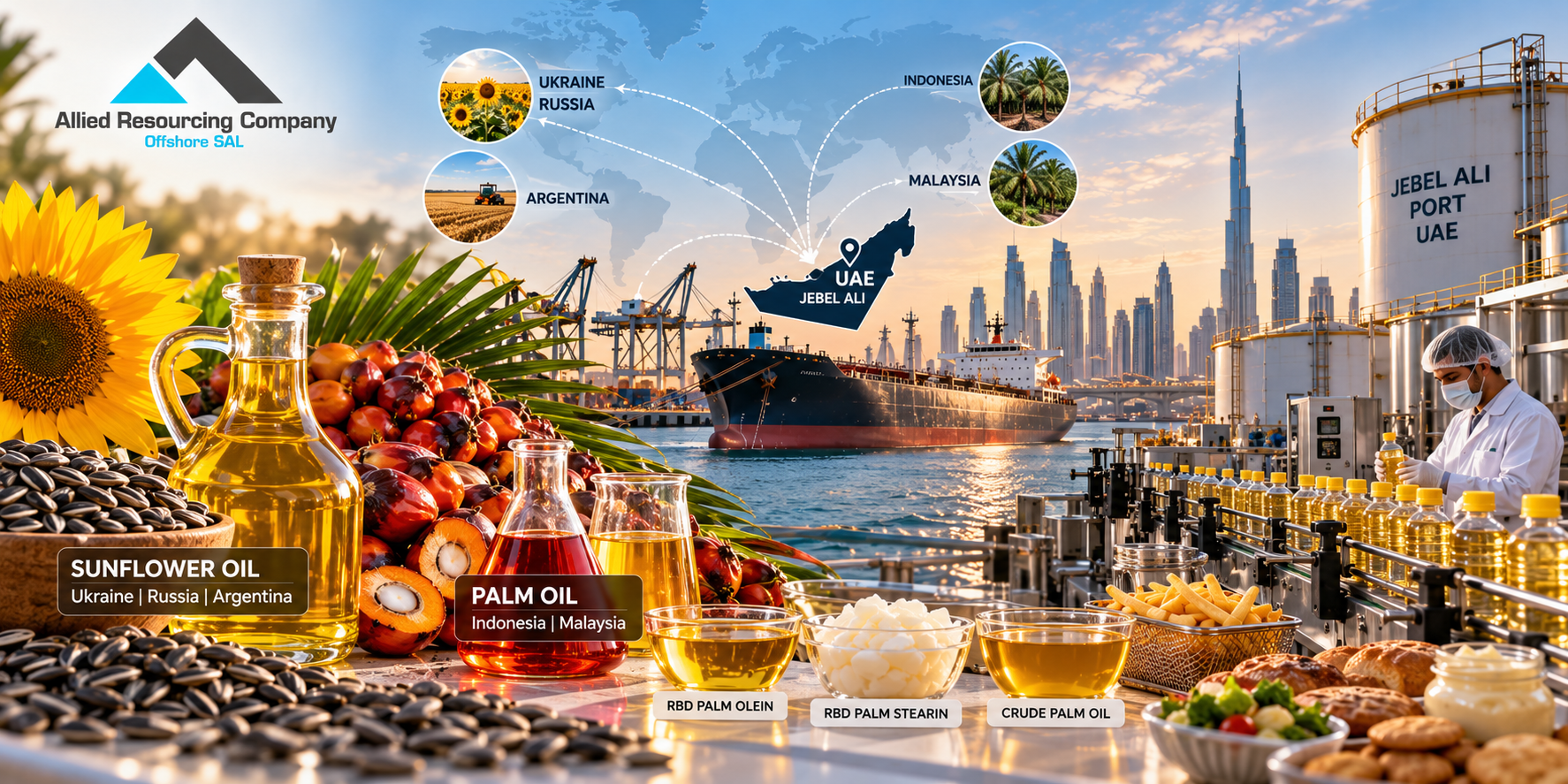
Edible oil is one of those inputs that nobody notices until it goes wrong. A bakery’s dough behaves differently. A snack line starts producing off-flavours after a few weeks on shelf. A frying operation burns through oil faster than planned. In almost every case, the root cause traces back to a specification that was too loose or a supplier that was not consistent.
For food manufacturers in the UAE, the stakes are higher than in many markets. The country is both a large consumer of edible oils and a regional hub that repacks and re-exports to the wider Gulf, East Africa and South Asia. Buyers here are often managing supply for their own production and for customers in several other countries at once. This guide is built around the questions those buyers actually ask when sourcing bulk sunflower oil and palm oil, in the order they usually need answering.
The choice between sunflower and palm is rarely about price alone.
|
Factor |
Sunflower Oil |
Palm Olein |
Palm Stearin |
|
Physical state at room temperature |
Liquid |
Liquid in warm climates, may cloud when cool |
Solid |
|
Flavour |
Light, neutral |
Neutral |
Neutral |
|
Typical uses |
Cooking oil, mayonnaise, dressings, light frying |
Industrial frying, snacks, noodles |
Margarine, shortening, bakery fats |
|
Oxidative stability |
Moderate (high oleic types higher) |
Good |
Good |
|
Retail consumer appeal |
Strong |
Moderate |
Not sold as retail oil |
Sunflower oil is the natural choice where a light, liquid oil with clean flavour is needed, especially for retail bottling, sauces and dressings. High oleic sunflower oil, bred for higher monounsaturated fat content, offers better frying stability and is increasingly requested by manufacturers who want a liquid oil that lasts longer in the fryer.
Palm olein is the workhorse of industrial frying. Its stability under heat makes it well suited to snack and noodle production, where oil is used continuously at high temperature.
Palm stearin is the solid fraction, used to build structure in margarine, shortening and bakery fats. Manufacturers often blend it with liquid oils to achieve the melting profile they need.
Many UAE plants use more than one oil, which is a good reason to consolidate sourcing through a single partner rather than managing separate supply chains.
This decision depends on your own facilities.
Crude oil is cheaper per tonne but needs refining before food use. Refining involves degumming, neutralising, bleaching and deodorising, often abbreviated as RBD for palm products. Buyers with their own refinery or a tolling arrangement can capture that margin.
Refined oil is ready to use or pack. Most food manufacturers without refining capacity buy refined products, and the specification focuses on the parameters that affect taste, stability and appearance.
The mistake to avoid is buying crude oil on price and then discovering that the refining yield, which depends heavily on the crude oil’s quality, makes the final cost higher than buying refined in the first place.
The Black Sea region, led by Ukraine and Russia, dominates global sunflower oil exports. Sunflower seed is harvested in late summer and early autumn, and new crop oil becomes available from around October.
Argentina is the other major origin. Its Southern Hemisphere harvest runs on a different calendar, which gives UAE buyers a useful second source and a way to manage supply between Black Sea crops.
Indonesia and Malaysia together account for the vast majority of global palm oil supply. Production is year round, though output follows seasonal cycles. Both countries maintain large refining sectors, so UAE buyers can source refined fractions directly rather than refining locally.
Sustainability certification, such as RSPO certified palm oil, is increasingly requested by multinational food brands and by export customers. If your customers require it, specify it from the start, because certified supply follows a separate chain of custody.
Two shipments from the same country can differ significantly. The refinery, the storage time before loading and the handling in transit all affect quality. Experienced buyers specify the product by parameters, not by country, and qualify the specific refinery or crushing plant. Working with an established sourcing and supply chain partner that knows which facilities deliver consistently is often the fastest way to avoid surprises.
A good edible oil specification is short, precise and measurable. These are the parameters most UAE food manufacturers include.
|
Parameter |
What It Tells You |
Why It Matters |
|
Free fatty acids (FFA) |
Degree of breakdown of the oil |
High FFA lowers smoke point and affects flavour |
|
Peroxide value (PV) |
Early oxidation |
High PV signals rancidity risk and shorter shelf life |
|
Moisture and impurities |
Water and foreign matter |
Affects stability and refining yield |
|
Colour (Lovibond) |
Visual appearance |
Important for retail bottling and product appearance |
|
Iodine value (IV) |
Degree of unsaturation |
Defines palm olein grades, for example IV 56, 58, 60 or 62 |
|
Cloud point |
Temperature at which oil turns cloudy |
Relevant for palm olein in air-conditioned retail and cooler export markets |
|
Slip melting point |
Melting behaviour |
Key for palm stearin in bakery and margarine |
|
Oleic acid content |
Fatty acid profile |
Distinguishes high oleic from standard sunflower oil |
Specify the maximum or minimum value for each parameter, the testing method, and where testing takes place: at loading, at discharge, or both. An independent surveyor taking samples at loading gives you a reference point if there is a dispute later.
Bulk vessels carry large parcels of oil in ship tanks and suit buyers with shore tank storage and high volumes.
Flexitanks are large single-use bladders fitted inside a standard 20 foot container. They are one of the most common formats for mid-sized manufacturers because they move edible oil in container quantities without dedicated tank infrastructure. Each container typically carries a little over 20 tonnes, depending on the oil and the flexitank size.
ISO tanks are reusable stainless steel tanks in a container frame. They offer strong protection for the product but require cleaning certificates showing the previous cargo, which is an important check for food grade oil.
Drums, jerrycans and retail bottles suit smaller buyers, distributors and manufacturers who need ready-packed oil.
For bulk formats, ask for the previous cargo history and cleaning certificate. Contamination from a non-food previous cargo is a rare but serious risk, and the documentation is your protection.
Most UAE-bound edible oil arrives through Jebel Ali, the country’s largest port, with its free zone used by many traders and repackers serving re-export markets.
Food products entering the UAE need to meet local food safety and labelling requirements. In practice, buyers should plan for:
Requirements are updated from time to time and can differ by emirate and by whether product is imported for local sale, production or re-export. Confirm the current position with your clearing agent before introducing a new product or origin.
Edible oil prices are among the most volatile in agro commodities. The main drivers are:
Because of this volatility, many UAE manufacturers combine contract purchases for base volume with spot purchases for flexibility. Locking in part of the annual requirement during favourable crop windows smooths costs across the year.
ARCOSAL supplies sunflower oil, palm oil, rapeseed oil and other agro commodities to food manufacturers and distributors across the Middle East. We work as an offshore purchasing department: qualifying refineries and crushers, agreeing the specification in writing, arranging independent inspection at loading, preparing consistent documentation and coordinating delivery into Jebel Ali and other UAE ports. Explore our sourcing and supply chain management services or visit arcosalbe.com to discuss your next edible oil requirement.
The UAE sources most of its sunflower oil from the Black Sea region, mainly Ukraine and Russia, and from Argentina. The choice depends on season, price and logistics conditions at the time of purchase.
Indonesia and Malaysia supply the vast majority of palm oil and palm fractions such as RBD palm olein and palm stearin to the UAE and the wider Gulf.
Palm olein is the liquid fraction of palm oil, widely used for frying. Palm stearin is the solid fraction, used in margarine, shortening and bakery fats.
Include free fatty acids, peroxide value, moisture and impurities, colour, and oleic acid content if buying high oleic oil. State the testing method and whether testing happens at loading, discharge or both.
A flexitank is a single-use bladder installed inside a 20 foot container. It allows edible oil to be shipped in container quantities without dedicated tank storage, which suits many mid-sized food manufacturers.
Jebel Ali is the main entry point, with its free zone widely used by traders and repackers serving re-export markets. Other UAE ports are used depending on location and volume.
Arabic labelling is required for retail packed food products sold in the UAE. Bulk oil for manufacturing follows different rules, so confirm requirements with your clearing agent.
Many combine both. Contract purchases secure base volume at a known price, while spot purchases add flexibility. Buying part of the annual requirement during strong crop windows helps manage volatility.