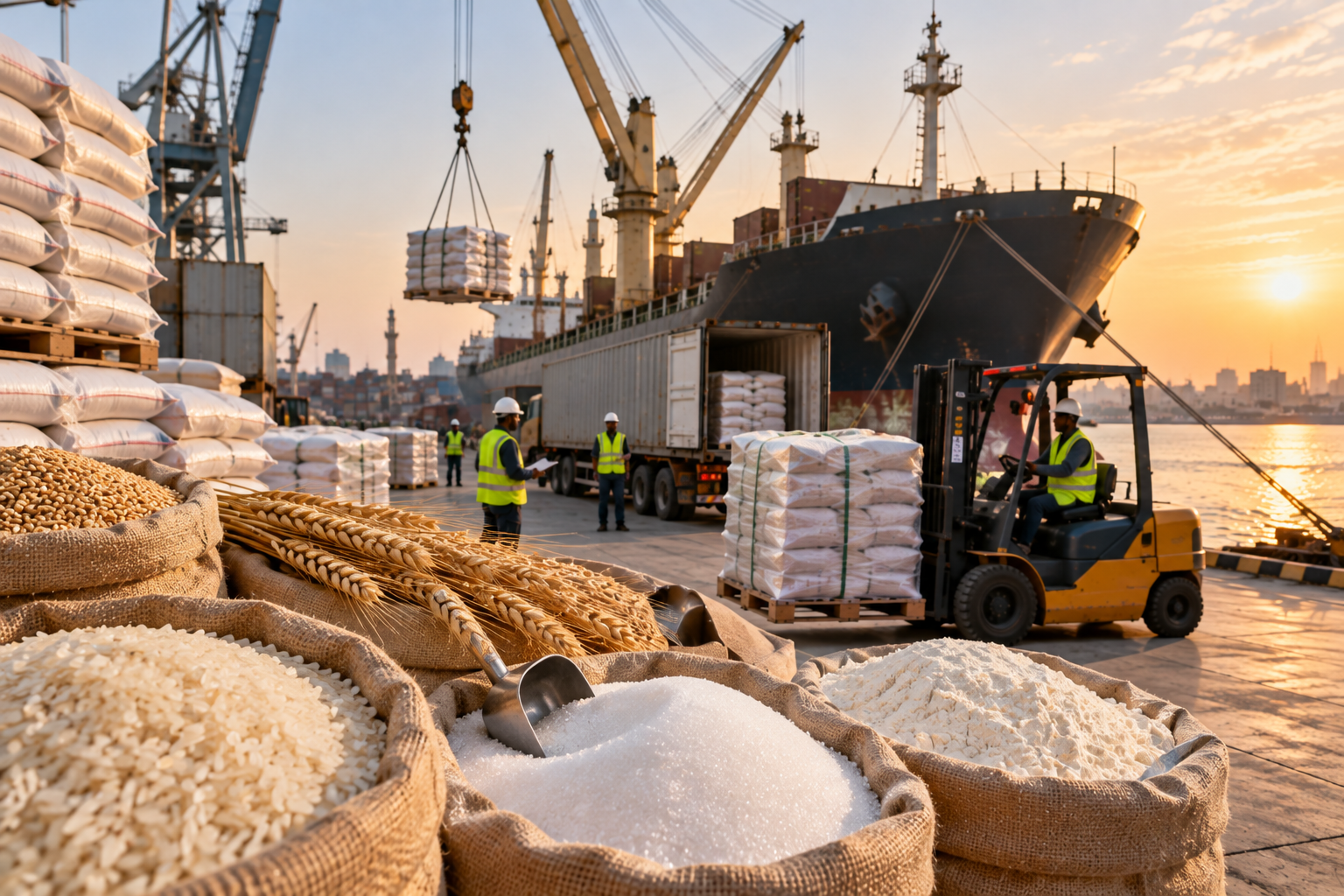
Quick Answer: Sugar, rice, and wheat flour import demand across West Africa continues to grow steadily, driven by population growth, urbanization, and limited domestic processing capacity relative to consumption needs. Buyers sourcing these commodities for the region should prioritize suppliers with established origin relationships, consistent quality grading, and documentation experience specific to West African customs and import procedures, since these three commodities each carry distinct sourcing considerations despite often being grouped together as staple food imports.
Sugar, rice, and wheat flour sit at the center of West Africa's food import economy because they form the backbone of daily diets across the region, from Nigeria and Ghana through to Senegal, Côte d'Ivoire, and beyond. Unlike some agricultural commodities where import dependency stems purely from climate limitations, the picture for these three products is shaped by a combination of factors that differ meaningfully from one commodity to the next.
Rice consumption across West Africa has grown substantially as urbanization shifts dietary preferences toward convenience staples, and while several countries in the region have invested significantly in domestic rice production, processing capacity and yield consistency have not fully closed the gap with rising consumption. Wheat, unlike rice, cannot be grown at meaningful scale across most of West Africa's climate zones, meaning wheat flour import dependency is structural rather than a temporary production shortfall. Sugar sits somewhere between the two, with some regional production capacity in countries with suitable growing conditions, but overall regional output falling well short of consumption needs driven by population growth and expanding food and beverage manufacturing.
Rice import demand for markets including Ghana continues to represent one of the most consistent and high-volume staple food trade categories in the region. A rice supplier Ghana relationship, and equivalent supply arrangements across neighboring countries, typically needs to account for the specific rice variety preferences that vary meaningfully by country and even by regional market within a single country. Parboiled rice holds strong preference across much of West Africa due to its cooking characteristics and storage stability, while white rice and specific grain length preferences vary by market segment and price point.
Sourcing origins for West African rice imports include established Asian exporters, particularly India, Thailand, and Vietnam, which together supply a significant share of the region's rice import volume, alongside growing volumes from South American origins as buyers diversify their supply base. For buyers and distributors, understanding which specific rice grade and variety a given market segment expects, rather than treating rice as a single undifferentiated commodity, is essential to building a supply relationship that actually matches regional consumer preference.
Quality and grading consistency matters significantly in this trade, since rice quality perception among West African consumers is well established and a shipment that does not match the expected grade, broken grain percentage, or cooking characteristic for a given market can face resistance in the retail channel even when technically meeting the letter of the purchase specification.
Wheat flour demand across West Africa has grown steadily alongside the expansion of bread consumption, bakery businesses, and food manufacturing that relies on flour as a base ingredient. Because wheat cultivation is not viable at meaningful scale across most of the region's climate zones, the wheat flour supply chain for West Africa depends almost entirely on either importing milled flour directly or importing wheat grain for milling within domestic or regional flour mills.
This creates two distinct sourcing pathways for a wheat flour exporter West Africa relationship to consider. Some buyers, particularly smaller bakeries and food processors, purchase already-milled flour directly, which simplifies their supply chain but places them at the mercy of the exporting mill's quality consistency and pricing. Larger buyers and regional milling operations more commonly import bulk wheat grain and manage milling domestically or regionally, which provides greater control over flour specification and consistency but requires the buyer to manage grain quality verification, milling logistics, and the additional documentation associated with bulk grain import rather than finished flour product.
Origin countries supplying wheat for West African milling and flour import include major grain-producing regions across the Black Sea area, North America, and increasingly South America, with buyers selecting origin based on a combination of price competitiveness, protein content suited to the specific bread and baked goods traditions of the destination market, and reliability of supply given the volume commitments large-scale milling operations require.
Sugar import demand across West Africa reflects both direct consumption needs and the requirements of a growing food and beverage manufacturing sector using sugar as a core ingredient in everything from soft drinks to confectionery and baked goods. A sugar importer West Africa relationship needs to account for the fact that sugar specifications vary depending on end use, with refined white sugar required for most direct consumption and beverage applications, while some industrial food manufacturing processes can accommodate less refined grades at a more competitive price point.
Regional sugar production exists in several West African countries, but domestic output generally falls well short of consumption needs, particularly as population growth and the expansion of food and beverage manufacturing continue to push demand upward. Import origins for sugar serving this market include Brazil, one of the world's largest sugar producing and exporting nations, alongside other major cane and beet sugar producing regions, with buyers selecting suppliers based on refined grade availability, consistent packaging standards suited to the destination market's retail and industrial requirements, and competitive pricing given sugar's relatively thin margin profile as a traded commodity.
While sugar, rice, and wheat flour each carry distinct sourcing considerations, the documentation and import clearance requirements share common ground that buyers across all three categories need to manage carefully.
Phytosanitary certificates confirming the shipment is free from pests and agricultural contamination are typically required for rice and wheat grain shipments specifically, while sugar and milled wheat flour may carry different but equally important food safety and quality certification requirements depending on the specific destination country's import regulations. Certificates of origin remain a standard requirement across all three commodity categories, establishing the source of the goods for customs classification and any applicable trade agreement benefits between the origin and destination countries.
Quality inspection at the point of loading, conducted by a recognized independent surveyor, is increasingly standard practice for bulk shipments of all three commodities, providing buyers with documented verification that the specification and grade being shipped matches what was agreed in the purchase contract before the goods depart the origin port. Buyers who skip this step and rely solely on the supplier's own quality documentation take on meaningfully more risk than those who build independent verification into their standard purchasing process.
Payment structures for sugar, rice, and wheat flour import transactions into West Africa generally follow the same commercial conventions common across international bulk commodity trade, with Letter of Credit remaining the most widely used and trusted instrument for transactions of meaningful size. This payment structure protects buyers by ensuring funds only release once the supplier presents shipping and quality documentation matching agreed contract terms, while giving suppliers the payment security of a bank-guaranteed mechanism once those conditions are satisfied.
FOB and CIF pricing structures both appear commonly in this trade, with the choice often depending on the buyer's own freight arrangement capabilities and existing relationships with shipping lines serving West African ports specifically. Buyers newer to direct international commodity importing frequently find CIF terms more manageable initially, since this shifts the logistics coordination responsibility to a supplier already experienced with the specific shipping routes and port procedures relevant to the buyer's destination country.
Given the volume and staple food significance of sugar, rice, and wheat flour trade into West Africa, buyers evaluating potential suppliers should prioritize a few specific factors beyond general price competitiveness. Confirm the supplier has demonstrated experience with the specific grade, variety, or specification your particular market segment requires, since generic commodity sourcing experience does not always translate into understanding the nuanced preferences that exist within rice varieties or flour protein content across different West African markets. Verify the supplier's track record with documentation and customs clearance specific to your destination country, since procedural requirements and processing efficiency vary meaningfully between neighboring countries in the region. Request references from other buyers currently sourcing similar volumes for comparable markets, and confirm the supplier can support the consistent, recurring volume your business requires rather than only being competitive on an occasional spot purchase basis.
ARCOSAL, Allied Resourcing Company Offshore S.A.L., sources sugar, rice, and wheat flour alongside a broader range of agro commodities including wheat, barley, soybean, and vegetable oils, working with established origins across the Black Sea region, Asia, and South America to supply distributors, mills, and food manufacturers across West Africa. As we extend our sourcing and supply chain services to buyers across Ghana and the wider West African region, our approach is built around understanding the specific grade, variety, and documentation requirements that each destination market and each commodity category demands.
You can review the full range of agro commodities we source on our Sourcing and Supply Chain page.
If your business is importing sugar, rice, or wheat flour into Ghana or elsewhere across West Africa and needs a sourcing partner who understands the specific requirements of this market, we are ready to discuss your requirements.
Contact the ARCOSAL team at Info@arcosalbe.com or visit arcosalbe.com to discuss your agro commodity sourcing needs for West Africa.