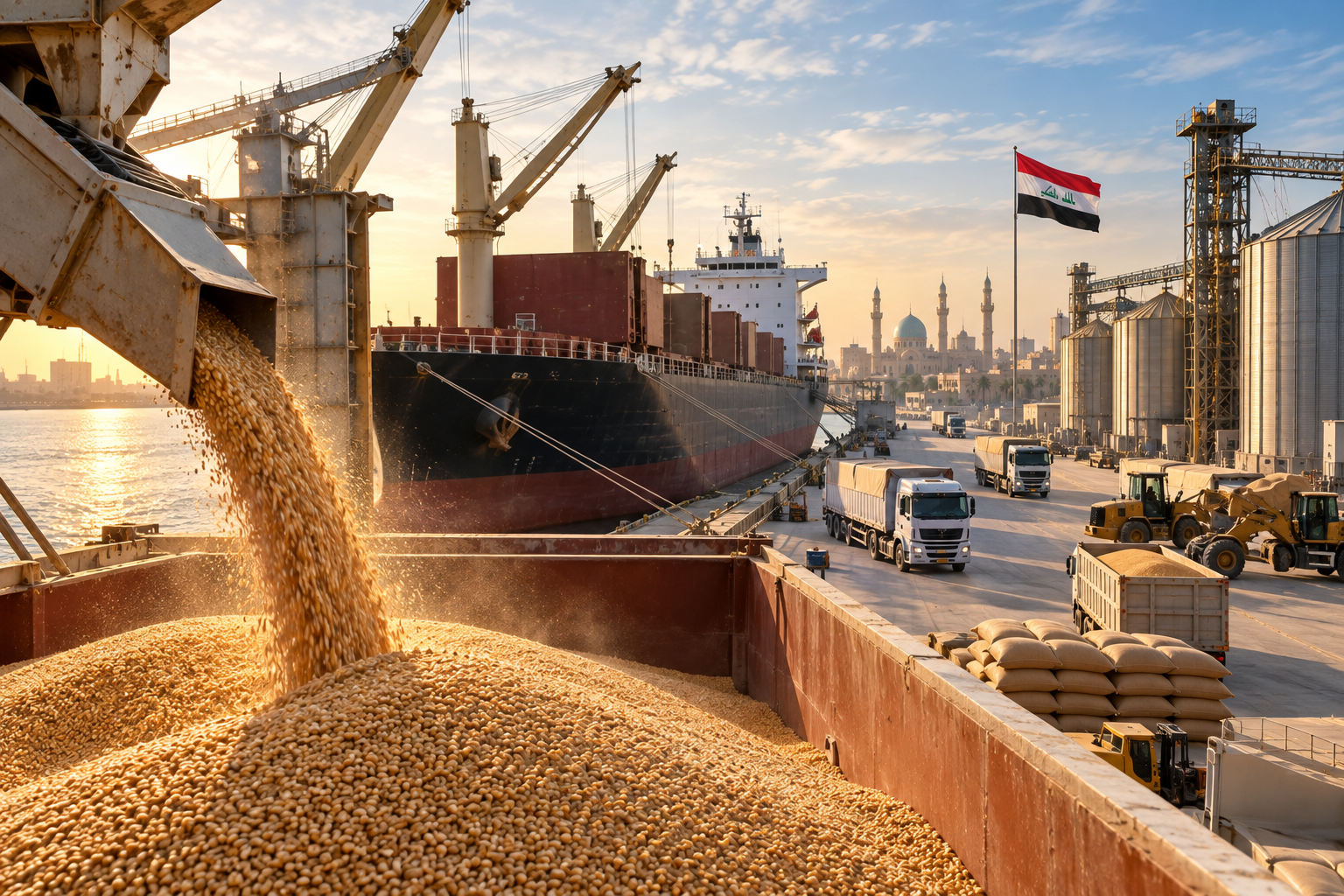
Quick Answer: Iraq's food manufacturing sector, including flour mills, bakeries, and processed food producers, depends almost entirely on imported wheat and grain because domestic production covers only a fraction of national consumption. Buyers sourcing bulk wheat for Iraq need to prioritize suppliers with direct origin relationships in major grain-exporting regions, verified quality and phytosanitary documentation, FOB or CIF pricing structured for the specific port of entry being used, and Letter of Credit payment terms that protect both sides of a high-volume grain transaction.
Iraq has a long agricultural history and domestic wheat production remains an active part of the country's economy, particularly across the fertile plains of the north. Despite this, domestic output has not kept pace with population growth, rising per capita consumption, and the expansion of flour milling and food processing capacity across the country. The result is a structural dependency on imported wheat, barley, and related grains that has defined Iraq's food supply chain for decades and shows no sign of reversing.
Several factors drive this gap. Water availability constraints affect irrigation capacity in key growing regions. Aging agricultural infrastructure limits yield per hectare compared to major exporting nations that have invested heavily in modern farming technology. Political and security disruptions over an extended period slowed the kind of long-term agricultural investment that would be needed to meaningfully close the production gap. Meanwhile, Iraq's population has grown substantially, and with it, demand for flour-based staple foods, bread, and processed grain products that form the core of the national diet.
For businesses operating flour mills, bakeries, and food manufacturing facilities inside Iraq, this dependency is not a temporary market condition to plan around. It is the operating reality, which makes reliable grain trading Iraq relationships a core business function rather than an occasional procurement task.
Iraq's food manufacturing sector is not a single homogenous buyer. It includes large-scale industrial flour mills supplying bread and pasta manufacturers, mid-size regional mills serving local bakeries and retail distribution, and food processors using wheat-derived ingredients in a broader range of packaged food products. Each of these buyer types has slightly different requirements, but they share common priorities when evaluating a bulk wheat supplier Iraq relationship.
Wheat is not a single uniform product. Hard wheat varieties with higher protein content are preferred for bread flour production, while softer wheat varieties suit certain pastry and confectionery applications. A flour mill running continuous production needs wheat that arrives at a consistent protein and moisture specification shipment after shipment, because variation in these properties directly affects milling yield and the quality of the finished flour. A wheat importer Iraq relationship that cannot guarantee this consistency creates production problems that compound the longer the relationship continues.
Iraq's food manufacturing demand operates at genuine bulk scale. Mills and processors are not placing occasional small orders. They require dependable access to full vessel or container load volumes on a recurring basis, month after month, to keep production running without interruption. This means suppliers need actual capacity behind their offers, not just a favorable spot quote that may not be repeatable at the same price or volume the following month.
Grain shipments entering Iraq require a specific set of documentation including phytosanitary certificates confirming the shipment is free from pests and plant diseases, certificates of origin, quality inspection certificates from a recognized surveyor confirming the grade and specification match the contract, and fumigation certificates where applicable. Delays in customs clearance caused by incomplete or incorrect documentation translate directly into demurrage costs at port and production disruptions for the buyer waiting on that shipment. A supplier experienced in grain trading Iraq specifically, rather than grain trading generally, understands these documentation requirements in detail and prepares them correctly before the vessel arrives rather than scrambling to correct errors after the fact.
Understanding the major origin countries supplying Iraq's wheat and grain import needs helps buyers evaluate whether a prospective supplier's origin claims are realistic and helps buyers diversify their own sourcing base intelligently.
The Black Sea region, including Russia, Ukraine, and neighboring grain-producing countries, has historically been one of the most significant sources of wheat for Iraq and the broader Middle East, owing to competitive pricing, proximity relative to other major exporters, and high production volumes from some of the most productive wheat-growing land in the world.
Australia is another established source of wheat for Middle Eastern markets including Iraq, known for high-quality hard wheat varieties well suited to bread flour production, though the longer shipping distance affects freight cost and transit time compared to Black Sea origins.
The United States and Canada supply wheat to Iraq periodically as part of broader Middle East trade flows, often through structured government or large-scale commercial procurement arrangements, offering high and consistent quality standards backed by well-established grain grading and export certification systems.
Argentina and other South American origins have grown in relevance for Middle East wheat and grain buyers over recent years, providing an additional diversification option outside of the traditional Black Sea and North American supply base, which matters for buyers who want to avoid overreliance on any single region.
A buyer working with a sourcing partner who maintains active relationships across multiple origins, rather than a single default source, is better positioned to manage price volatility and supply disruption than one dependent on a single region's harvest and export conditions.
Grain trading operates on internationally standardized commercial terms that every serious buyer needs to understand before negotiating a contract.
FOB and CIF pricing are the two most common structures. Under FOB, or Free On Board, the buyer takes responsibility for freight and insurance once the grain is loaded onto the vessel at the origin port, meaning the buyer typically arranges their own shipping. Under CIF, or Cost, Insurance, and Freight, the seller arranges and pays for shipping and insurance up to the destination port, and the price quoted already includes those costs. Buyers new to wheat importer Iraq trade often prefer CIF pricing initially because it simplifies logistics, while more established buyers with their own freight relationships may prefer FOB to control that cost independently.
Quality specifications in the contract need to explicitly define protein content range, moisture content maximum, foreign material tolerance, and grade classification, with an agreed independent inspection process at loading and, where the contract allows, at discharge as well. Vague quality language in a grain contract is one of the most common sources of dispute in this trade, particularly when a shipment arrives and the buyer's own testing shows results that differ from what the supplier's documentation claims.
Payment terms for bulk grain transactions of this scale are almost universally structured around Letters of Credit, which protect the buyer by ensuring payment only releases once the supplier presents shipping and quality documents that match the contract terms, and protect the supplier by providing a bank-guaranteed payment mechanism once those conditions are met. A supplier unwilling to operate under Letter of Credit terms for a first-time or ongoing relationship at this transaction size should be viewed with real caution.
For a food manufacturer or trading company in Iraq evaluating a new grain supplier relationship, a structured evaluation process reduces risk significantly compared to moving quickly on an attractive spot price without proper diligence.
Confirm the supplier's actual access to origin, meaning whether they have direct relationships with grain exporters, elevators, or processing facilities, or whether they are intermediating on the spot market without guaranteed forward access to volume. Request sample documentation from a recent comparable shipment, including certificates of origin, phytosanitary certificates, and quality inspection reports, before committing to an order. Clarify exactly which port of entry in Iraq the shipment will be delivered to and confirm the supplier has experience with the specific customs and handling requirements at that port. Agree on quality specifications and inspection procedures in writing before the contract is finalized, not verbally during a phone call. A Confirm Letter of Credit is an available and standard payment structure for the transaction size being discussed.
None of these steps are unusual requirements in professional grain trade. A supplier with genuine experience serving Iraq's market will meet each of them without resistance, because this is simply how serious international grain trade is conducted.
ARCOSAL, Allied Resourcing Company Offshore S.A.L., sources bulk wheat, wheat flour, barley, and related agro commodities from established origins including the Black Sea region, Europe, and beyond, supplying food manufacturers, mills, and distributors across the Middle East, including buyers in Iraq's growing food manufacturing sector.
Our approach to grain trading Iraq relationships is built around direct origin relationships rather than spot market intermediation, complete documentation prepared and verified before shipment, and Letter of Credit payment structures that give both parties commercial security. You can review the full range of agro commodities we source, including wheat, wheat flour, barley, and related grains, on our Agro Commodities page.
Whether your business is a flour mill requiring consistent monthly volume, a food processor sourcing specific grain grades, or a distributor building out a diversified supply base across multiple origins, ARCOSAL manages the sourcing, documentation, and logistics complexity so your production runs without the supply interruptions that come from unreliable grain trading relationships.
Contact the ARCOSAL team at Info@arcosalbe.com or visit arcosalbe.com to discuss your bulk wheat and grain sourcing requirements for Iraq.