Every food processor sourcing frozen vegetables at scale will at some point face the same procurement question: does the application actually require IQF, or will fresh frozen deliver the same result at a lower cost? It sounds like a straightforward question. In practice, the answer depends on the specific vegetable, the production process it is going into, and what the finished product needs to look, taste, and perform like at the point of consumption. Getting this decision wrong in either direction costs money. Buying IQF when fresh frozen would have worked means paying a premium you did not need to pay. Buying fresh frozen when your application needed IQF means dealing with yield loss, texture problems, and quality inconsistency that eat into your margins in ways that are harder to measure but just as real.
This guide gives food processors the information they need to make the right call for their specific situation.
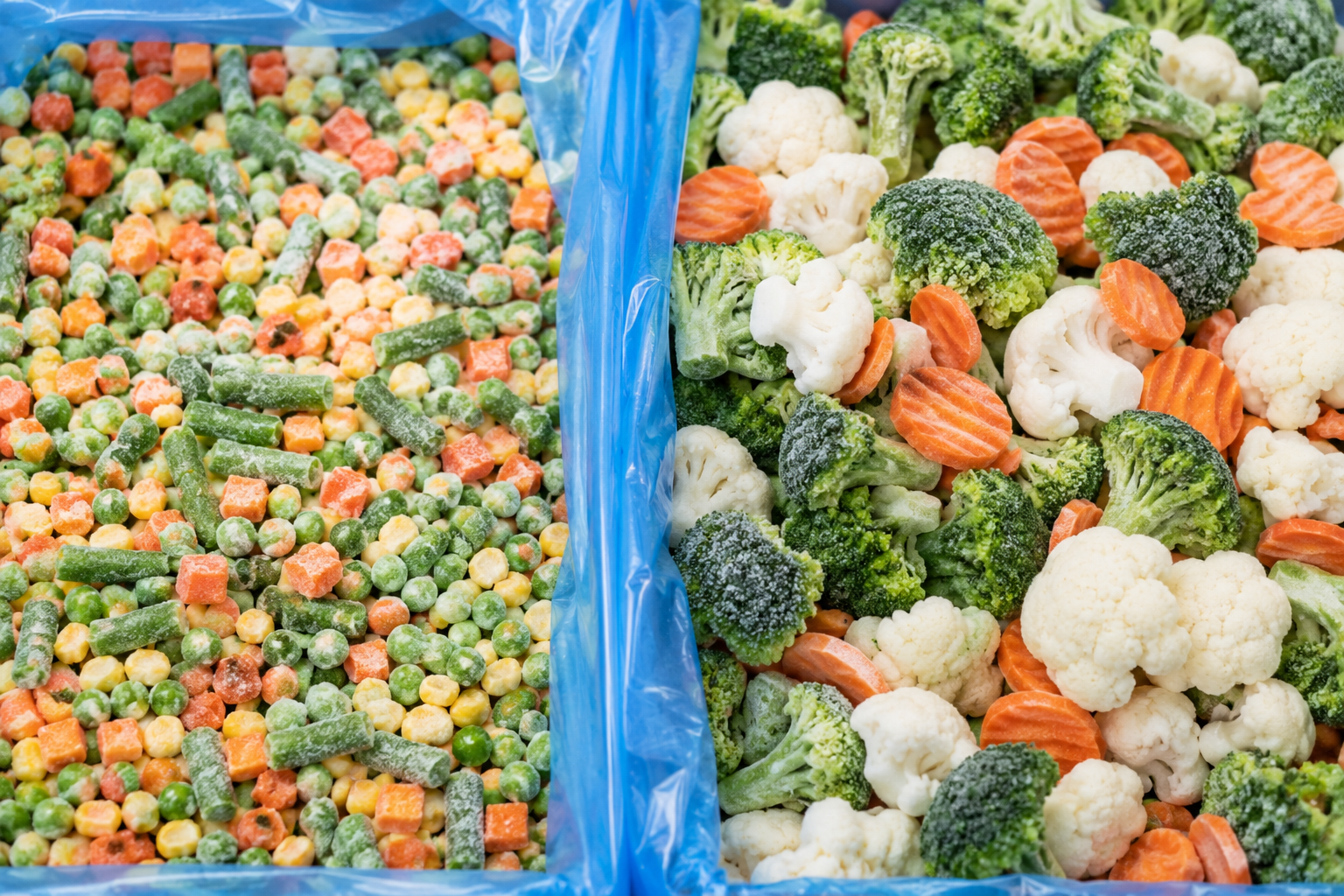
IQF food processing freezes each individual vegetable piece separately and rapidly, surrounding it with high-speed cold air in a freezing tunnel or drum until the core temperature drops to minus 18 degrees Celsius or below. The speed of the process keeps ice crystals small, which means cell walls remain largely intact and the vegetable piece holds its structure, colour, and texture through freezing, storage, transit, and thawing.
Fresh frozen, sometimes called block freezing, works differently. Vegetables are placed into trays or containers in bulk and frozen together as a mass. The freezing process is slower because cold needs to penetrate through the entire block rather than surrounding each individual piece. Slower freezing produces larger ice crystals, which rupture cell walls and cause structural breakdown that becomes visible the moment the product is thawed. The vegetable releases liquid, loses its texture, and in many cases loses colour intensity and flavour alongside it.
The performance gap between these two methods is not theoretical. It shows up in production yield, in finished product quality, and in the consistency of results across batches. The question for any frozen vegetable supplier relationship is whether that performance gap matters for the specific application the buyer is running.
IQF vegetables vs fresh frozen is not a debate where one method always wins. IQF wins when the application requires the vegetable piece to retain its individual identity in the finished product.
Consider a premium ready meal where the consumer expects to see and bite into distinct pieces of sweet corn, green peas, or diced onion. The visual presentation of those pieces in the finished dish is part of what the consumer is paying for. An IQF frozen vegetable supplier delivers product where each piece is separate, free-flowing, and structurally intact after thawing. The same product sourced as fresh frozen will thaw into a mass where individual pieces have partially broken down, releasing liquid into the dish and losing the firm texture that makes the ingredient feel fresh rather than processed.
The same logic applies to ingredients that are visible in the finished product photography, used in premium food service plating, or incorporated into products where texture is a core part of the sensory experience. Spinach in a premium pasta filling, okra in a restaurant-quality curry, whole green peas in a retail side dish, these are applications where the structural integrity that IQF food processing delivers is not a nice-to-have. It is a specification requirement.
Portion control is another practical reason food processors choose IQF over fresh frozen. A bag of IQF green peas allows a production line to measure exact portions without thawing an entire block, weighing it, and managing the mess and waste that comes with it. Over the course of a full production year, the operational efficiency of working with free-flowing IQF product adds up to a meaningful cost saving that partially or fully offsets the price premium over fresh frozen.
Fresh frozen is not an inferior product in the wrong context. It is a cost-effective choice for specific applications where the structural breakdown that comes with block freezing does not affect the quality of what ends up on the consumer's plate or in their glass.
Soup manufacturing is the clearest example. A vegetable that will be cooked in liquid for twenty minutes and then blended or left to soften in a broth does not need to arrive as a structurally intact IQF piece. The cell wall damage from block freezing is irrelevant when the application is going to break down the vegetable structure through cooking regardless. Buying fresh frozen spinach or diced onion for a soup base rather than IQF vegetables at a premium price is a rational procurement decision that does not compromise finished product quality in any way the consumer would detect.
The same applies to puree and concentrate manufacturing, where the vegetable is going to be cooked down and processed into a paste or liquid product. Juice concentrate production, tomato paste manufacturing, and vegetable puree operations are all applications where fresh frozen delivers the raw material the process needs at a lower cost than IQF, with no negative consequence for the finished product.
Industrial sauce and ready meal component manufacturing where vegetables are cooked into a sauce base, heavily seasoned, or combined with other strong flavour elements that mask any texture variation are also categories where fresh frozen is a commercially sensible choice that experienced procurement teams make deliberately rather than by default.
One of the most important things a food processor needs to understand when comparing IQF vegetables vs fresh frozen on price is that the headline cost per kilogram is not the complete comparison. The yield after thawing is.
Fresh frozen vegetables release a significant amount of liquid during thawing because the cell wall damage from larger ice crystals allows the moisture inside the vegetable cells to escape. Depending on the specific vegetable and the freezing method used, the drip loss from fresh frozen product can be substantially higher than from an equivalent IQF product. That drip loss is weight you paid for and cannot use.
When a food processor calculates the cost per kilogram of usable vegetable after accounting for drip loss, the price gap between IQF and fresh frozen often narrows considerably. For applications with high throughput volumes where even a small difference in yield per kilogram compounds across thousands of kilograms of purchases, the yield-adjusted comparison can shift the procurement decision toward IQF even when the headline price is higher.
This calculation is worth running explicitly before making a sourcing decision based on headline price alone. A frozen vegetable supplier who understands your production process should be able to help you work through it based on the specific product and application you are sourcing for.
Whether a food processor is sourcing IQF or fresh frozen vegetables, the fundamentals of evaluating a frozen vegetable supplier do not change. Cold chain integrity from processing facility to destination remains the baseline requirement because both IQF and fresh frozen product degrades when the cold chain is broken and neither can be reliably recovered once partial thawing has occurred.
Product specification in writing before the order is confirmed protects both parties and eliminates the ambiguity that causes disputes. Maximum glazing percentage, shelf life remaining at time of shipment, origin country and specific processing facility, and packaging format are specifications that should be locked down regardless of whether the product being sourced is IQF or fresh frozen.
Traceability documentation from farm to container is increasingly a non-negotiable requirement for food manufacturers supplying major retail chains. A frozen vegetable supplier who can provide full origin traceability records alongside standard export documentation is a supplier who meets the compliance requirements of regulated retail supply chains rather than one who creates documentation problems at the audit stage.
At ARCOSAL, we source both IQF vegetables and other frozen produce for food manufacturers, beverage producers, and retail distributors across Europe, the Middle East, and beyond. Our IQF range covers spinach, diced onions, diced garlic, okra in whole and cut formats, green peas, and sweet corn kernels, sourced directly from certified processing facilities across China, Egypt, India, Vietnam, and other key origins.
We work with food processors at the specification stage, not just at the point of placing an order, because getting the origin, format, and specification right for the application produces better results than sourcing the cheapest available product and adjusting the production process to accommodate what arrives.
Every shipment includes full cold chain documentation, traceability records, and product specification confirmation before loading. We handle supplier vetting, quality checks, documentation, and logistics end to end so that the product our buyers receive performs exactly as specified in their production environment.
If your operation is evaluating IQF food processing raw material suppliers or looking for a more reliable source of frozen vegetables for your production lines, we are ready to discuss what your application actually needs.
Contact the ARCOSAL team at Info@arcosalbe.com or visit arcosalbe.com to explore our full IQF and frozen vegetable sourcing capabilities.