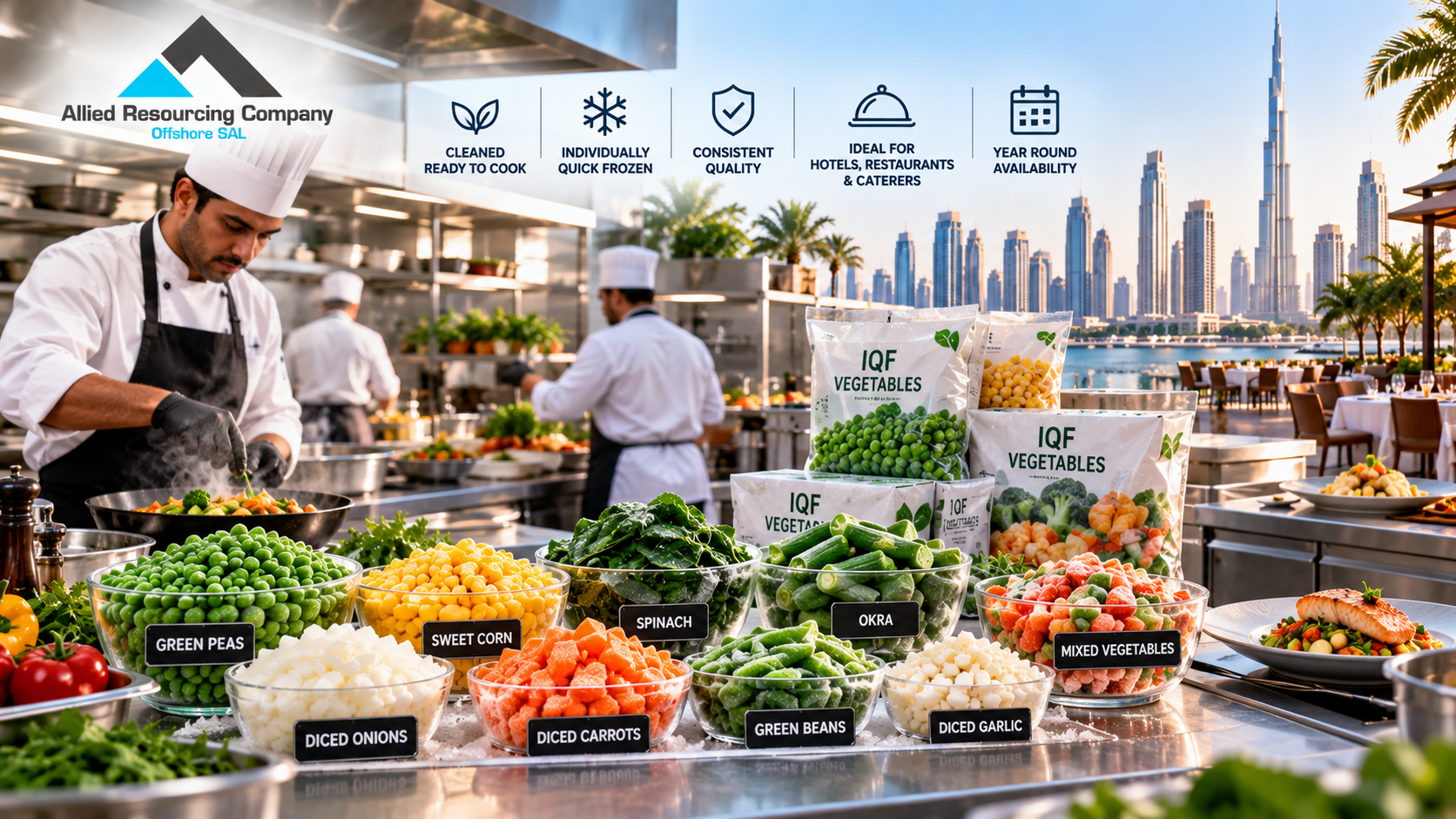
It is 6:30 on a Friday morning in a five-star hotel kitchen in Dubai. Brunch starts in five hours. The banquet team needs vegetables for 600 covers, the all-day dining outlet needs its usual mise en place, and the Indian specialty restaurant upstairs wants okra for its signature dish. The fresh produce delivery is late, the spinach that did arrive is wilted at the edges, and two prep cooks have called in sick.
Kitchens that run on IQF vegetables handle mornings like this very differently. The peas, corn, spinach, okra and diced onion are already in the freezer, already cleaned and cut, already portioned in packs the team knows by heart. Nobody is washing, peeling or trimming. Nothing is thrown away.
This is why IQF vegetables in Dubai’s HORECA sector have moved from a back-up option to a core part of how professional kitchens operate. This guide explains how different kitchen types use them, which products earn their place, how to judge quality, and what to look for in a supplier.
Three features of the Dubai market make IQF vegetables especially valuable here.
Almost everything is imported. The UAE grows some produce, but the vast majority of the vegetables used in Dubai kitchens arrive by air, sea or road from abroad. Fresh produce that has travelled thousands of kilometres has already lost part of its shelf life before it reaches the kitchen door. IQF vegetables are frozen within hours of harvest, locking in quality at origin.
Demand swings sharply. Ramadan iftar and suhoor buffets, the winter tourist peak, major exhibitions and conferences, weddings and the summer slowdown all change volumes dramatically. Fresh produce does not scale up and down easily. A freezer stocked with IQF product does.
Labour is a major cost. Every hour a cook spends peeling onions or picking spinach is an hour not spent on finished dishes. IQF vegetables arrive ready to cook, which lets kitchens run with leaner prep teams or redeploy staff to higher value work.
Large hotels run several outlets from one central kitchen: banqueting, all-day dining, room service, staff canteen and specialty restaurants. They need consistency across outlets and across shifts. IQF vegetables deliver the same cut, colour and texture whether the dish is cooked by the morning team or the night team, and whether it serves 20 guests or 1,000.
Hotel banqueting is where IQF shines most. Large batch cooking for weddings, conferences and iftar buffets needs vegetables that can be portioned quickly, cooked evenly and held well on a buffet line.
Independent restaurants and restaurant groups care about food cost control and menu consistency. A restaurant using IQF green peas knows exactly how many portions a 2.5 kg bag yields, because there is no trim loss. That makes costing accurate and protects margins.
Cuisine matters too. Dubai’s restaurant scene covers Arabic, Indian, Pakistani, Persian, Asian, European and fusion menus. Okra for bamia and bhindi masala, spinach for saag and fatayer, peas for biryani and pulao, sweet corn for soups and salads: IQF covers a wide range of the vegetables these cuisines depend on.
Contract caterers serving offices, schools, hospitals, construction camps and airlines work at the largest volumes and tightest margins. For them, IQF vegetables are less about convenience and more about predictable cost and food safety. Product that has been blanched and frozen under controlled conditions carries lower microbiological risk than fresh produce handled multiple times through a long supply chain.
Dubai’s delivery-led food businesses run from compact kitchens with limited storage and small teams. IQF vegetables suit them well: compact freezer storage, no prep space needed, and consistent portioning across multiple virtual brands operating from the same kitchen.
Not every vegetable needs to be frozen, and not every frozen vegetable performs equally. The lines below are among the most practical for Dubai HORECA kitchens.
|
IQF Vegetable |
Typical Kitchen Uses |
What to Specify |
|
Green peas |
Biryani, pulao, soups, sides, curries |
Size grade, sweetness, tenderness, colour |
|
Sweet corn |
Soups, salads, sides, pizza, Asian dishes |
Kernel size, colour, sweetness, absence of cob fragments |
|
Spinach |
Saag, fatayer, pies, sauces, stews |
Leaf, chopped or portion balls, stem content |
|
Okra |
Bamia, bhindi masala, stews |
Whole or cut, pod length, tenderness |
|
Diced onions |
Base for curries, sauces, stocks, stews |
Dice size, free flow, absence of skin |
|
Diced garlic |
Marinades, sauces, sautés |
Dice or crushed format, free flow |
|
Mixed vegetables |
Volume cooking, staff meals, sides |
Component ratio, uniform cut size |
Diced onions and diced garlic deserve special mention. They are among the highest labour savings any kitchen can make, they remove the eye-watering, time-consuming prep task entirely, and they cook directly from frozen.
Explore the full range of products ARCOSAL supplies on our IQF fruits, vegetables and canned food page.
Many purchasing managers compare IQF and fresh vegetables on price per kilo and conclude that fresh is cheaper. That comparison misses most of the cost.
Fresh vegetables carry trim loss: onion skins and ends, spinach stems and damaged leaves, pea pods. They carry spoilage loss: product that wilts or rots before it is used, especially in Dubai’s climate. And they carry labour cost: washing, peeling, cutting and cleaning up afterwards.
IQF vegetables carry almost none of these. Every gram in the bag is usable, and the bag can be resealed and returned to the freezer.
A fair comparison asks one question: what does one usable kilo, ready for the pan, actually cost? Once trim, spoilage and labour are included, IQF is often equal to or cheaper than fresh for many lines, before even counting the value of consistency and food safety.
When samples arrive, these are the checks that separate good IQF product from poor product.
Free flow. Pieces should pour separately from the bag. Clumping indicates the product partially thawed and refroze somewhere in the cold chain.
Ice crystals and frost. A light frost is normal. Heavy ice crystals inside the bag point to temperature fluctuation and moisture loss, which affects texture.
Colour. Peas and spinach should be bright green, corn a clear yellow. Dull or faded colour can mean poor blanching or old stock.
Cut uniformity. Diced onions, cut okra and mixed vegetables should be consistent in size so they cook evenly.
Defects. Look for foreign material, discoloured pieces, stems in spinach, cob fragments in corn and damaged pods in okra. Agree a defect tolerance with the supplier.
Cooked performance. Cook a sample the way your kitchen would. Texture, flavour and how the product holds on a buffet line matter more than how it looks in the bag.
IQF vegetables are only as good as the last link in the cold chain, and in Dubai that link is often the most exposed.
The busiest weeks of the year are the worst time to discover a supplier is short. Experienced purchasing teams in Dubai forecast their IQF vegetable needs for Ramadan, the winter tourist season and major event calendars months in advance, then agree volumes with their supplier early. Because Ramadan moves earlier each year on the Gregorian calendar, last year’s plan needs adjusting every year. Ordering ahead also lets product travel by sea at normal freight rates rather than in a rush, and gives the kitchen time to test any new product before it reaches a buffet line serving hundreds of guests.
The right supplier is not simply the one with the lowest price list. For HORECA buyers, these questions matter most:
A supplier who answers all six with evidence, not just promises, is one worth building a relationship with.
ARCOSAL sources IQF vegetables, IQF fruits, juice concentrates and canned foods from qualified processors across multiple origins, supplying distributors, food service operators and manufacturers in the UAE and the wider region. We qualify each processing facility, agree specifications in writing, verify quality before loading and manage cold chain logistics through to Jebel Ali. See our IQF and canned food range, learn how our sourcing and supply chain management model works, or visit arcosalbe.com to speak with our team.
IQF stands for Individually Quick Frozen. Vegetables are cleaned, cut, usually blanched, and frozen rapidly so each piece freezes separately. This preserves colour, texture and nutrients and lets kitchens use exactly the quantity they need.
For many uses, yes. IQF vegetables are frozen within hours of harvest, while imported fresh produce may travel for days. For cooked dishes such as curries, soups, rice dishes and buffet items, good quality IQF products perform very well.
Green peas, sweet corn, spinach, okra, diced onions, diced garlic and mixed vegetables are among the most widely used, reflecting the Arabic, Indian, Pakistani and international cuisines popular in Dubai.
At -18°C or colder. Product should be checked on delivery, moved to the freezer immediately and never refrozen after thawing.
On price per kilo, sometimes not. On cost per usable kilo, after trim loss, spoilage and prep labour, IQF vegetables are often equal or cheaper for many lines.
Hotels and restaurants commonly use 1 kg and 2.5 kg bags, while central kitchens and caterers often buy larger bulk cartons. A good supplier offers both.
Look for clumping, heavy ice crystals inside the bag, and soft or mushy texture after cooking. Free flowing pieces with light frost usually indicate a well maintained cold chain.
Yes. Most IQF vegetables are designed to go straight from freezer to pan, pot or steamer, which saves time and preserves texture.