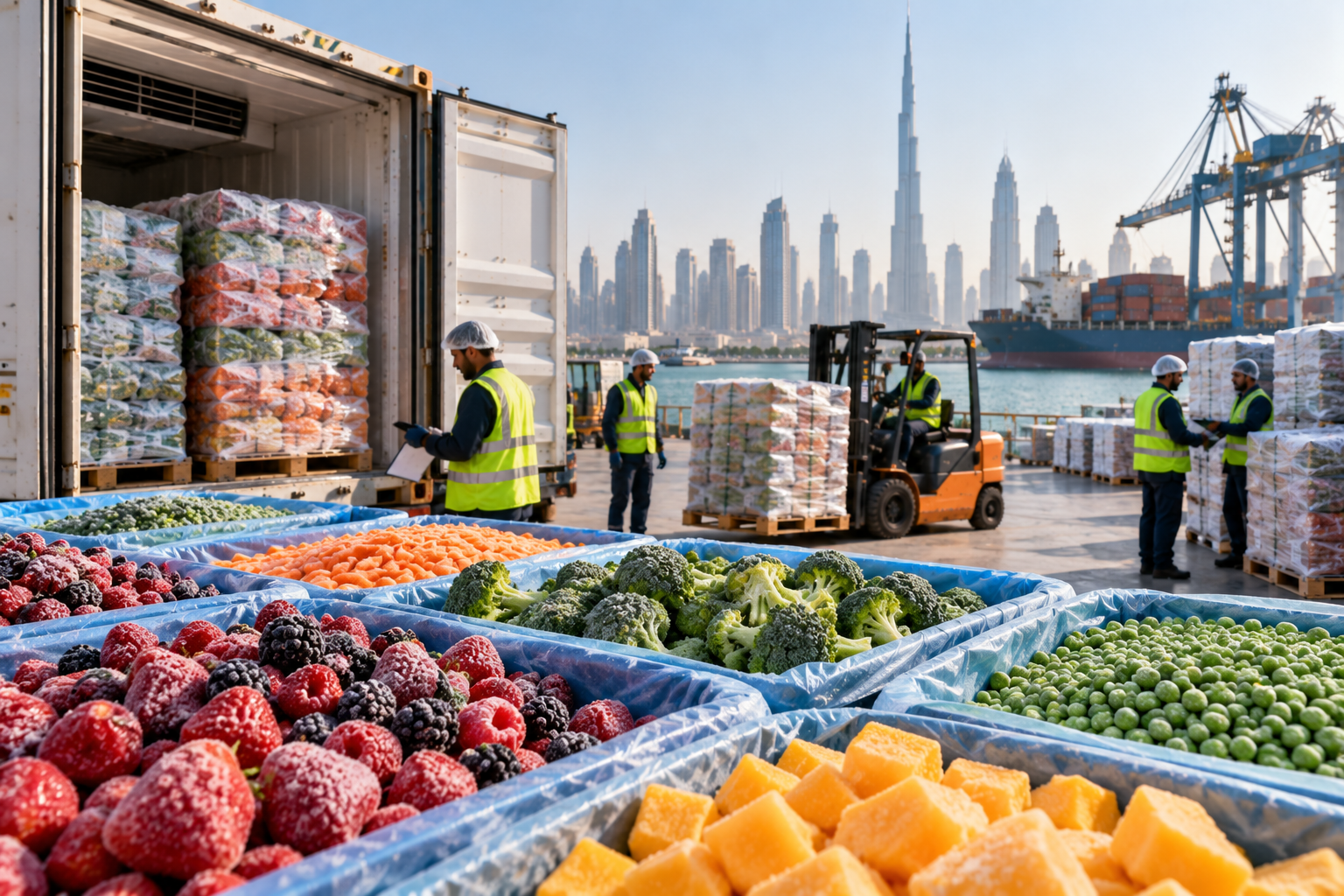
Quick Answer: Food manufacturers in the UAE sourcing IQF fruits and vegetables need suppliers who can guarantee year-round supply continuity across multiple origin countries, meet the UAE's specific food safety and import documentation standards enforced by Dubai Municipality and federal authorities, and provide product specifications matched to whether the application is retail-facing, food service, or industrial processing, since the UAE's food manufacturing sector spans all three at significant scale.
The UAE imports the overwhelming majority of its food supply, a reality driven by the country's arid climate, minimal arable land, and limited freshwater resources for large-scale agriculture. This dependency extends directly into the food manufacturing sector, where dairy producers, bakeries, beverage manufacturers, and ready meal producers building products for both the domestic UAE market and re-export across the wider Gulf region rely almost entirely on imported IQF fruits and vegetables as raw material inputs.
What makes this market distinct from many other IQF-importing regions is the dual role the UAE plays. A significant share of frozen produce entering the country through Dubai's ports is destined for genuine domestic food manufacturing and consumption, while another substantial share moves through as part of re-export supply chains reaching food manufacturers and distributors across Saudi Arabia, Oman, Qatar, and beyond. A frozen vegetables importer UAE business therefore often needs sourcing relationships robust enough to serve both purposes simultaneously.
For a food manufacturer building products at commercial scale, the choice between IQF and alternative frozen formats is rarely close once production requirements are properly understood. IQF's individually frozen structure means a manufacturer can measure exact portions from a single bag without thawing an entire block, a practical advantage that speeds up production lines and reduces waste in continuous manufacturing environments. The structural integrity that comes from rapid individual freezing also means the finished product, whether a smoothie with visible fruit pieces, a bakery filling requiring intact fruit structure, or a savory dish with distinct vegetable components, performs at a quality level that block frozen alternatives typically cannot match.
For IQF vegetables UAE buyers specifically supplying premium retail brands or export-quality finished products, this quality difference is not a marginal consideration. It is frequently the specification standard that a retail buyer or export market requires as a baseline condition of the contract.
The range of IQF fruits and vegetables moving into UAE food manufacturing facilities spans a broad set of applications across several manufacturing sub-sectors.
Dairy and beverage manufacturers source IQF strawberries, blueberries, raspberries, and mango extensively for yogurt production, flavored milk products, and smoothie and juice manufacturing, where fruit piece visibility and flavor intensity are central to the product proposition. Bakery manufacturers use IQF fruits including strawberries, apricot halves, and sour cherry in fillings, toppings, and pastry applications where the fruit needs to retain structural integrity through baking processes.
On the vegetable side, IQF spinach, green peas, sweet corn kernels, and diced onions and garlic move into ready meal production, sauce and prepared food manufacturing, and food service supply chains serving the UAE's substantial hospitality and catering sector. Okra, in both whole and cut formats, sees particular demand tied to regional cuisine preferences across South Asian and Middle Eastern culinary traditions well represented in the UAE's diverse population and food service landscape.
Importing IQF produce into the UAE requires meeting food safety and documentation standards enforced through a combination of federal regulation and emirate-level authorities, with Dubai Municipality's Food Safety Department playing a central role for goods entering through Dubai specifically. Understanding these requirements before committing to a supplier relationship prevents costly delays and rejected shipments.
Products need to arrive with health certificates confirming compliance with food safety standards from the exporting country's competent authority, alongside certificates of origin and, depending on the specific product, additional certification confirming compliance with the UAE's specific labeling and food safety requirements. The UAE has increasingly aligned its food import standards with international frameworks including Codex Alimentarius guidelines, but buyers should not assume documentation acceptable in one destination market automatically satisfies UAE-specific requirements without direct confirmation.
For an IQF fruits supplier Dubai relationship specifically, working with a supplier who already has an established track record shipping into UAE ports and understands Dubai Municipality's specific inspection and clearance procedures materially reduces the risk of documentation-related delays that can otherwise disrupt a manufacturer's production schedule.
One of the most important sourcing decisions a UAE food manufacturer makes is how to structure supply across the calendar year, given that no single IQF fruit or vegetable origin produces continuously across all twelve months. A manufacturer sourcing IQF strawberries exclusively from a single North African origin, for example, faces a supply gap the moment that region's harvest season ends unless the sourcing relationship extends to complementary origins in other hemispheres or growing regions.
Experienced frozen vegetables importer UAE operations typically structure their sourcing across multiple origins deliberately, drawing on Egyptian and Moroccan production during North African harvest windows, transitioning to Peruvian and Chilean sourcing for Southern Hemisphere coverage, and incorporating Serbian and Eastern European origins for specific fruits like sour cherry and certain berry varieties where that region offers particular quality advantages. Vegetables including spinach, garlic, and onions are sourced heavily from China, Egypt, and India, with origin selection driven by specification requirements, seasonal pricing, and the specific certification standards required for the destination market.
A food manufacturer attempting to manage this multi-origin complexity independently, negotiating separately with suppliers across five or six countries to maintain year-round continuity, faces a substantial coordination burden. This is precisely where working with a sourcing partner who already maintains active relationships across these origins simplifies the manufacturer's own procurement process significantly.
Beyond origin and format decisions, UAE food manufacturers need to define specific product parameters clearly before committing to volume orders, since generic specifications create quality inconsistency that shows up directly in finished product performance.
Caliber and piece size need to match the specific application, whether that is whole fruit pieces visible in a premium yogurt product or diced formats suited to industrial sauce production. Brix level matters significantly for beverage and dairy applications where flavor intensity directly affects finished product taste profile. Glazing percentage, the ice coating applied during IQF processing, should be specified with a clear maximum in the purchase contract, since excessive glazing effectively means paying for water weight rather than usable product, a cost that compounds meaningfully across high-volume manufacturing purchases. Shelf life remaining at time of shipment should provide adequate buffer given transit times from origin countries to UAE ports, typically requiring a minimum of twelve months remaining from production date to accommodate shipping, customs clearance, and reasonable stock rotation before the product enters production.
Food manufacturers evaluating a new IQF vegetables UAE sourcing relationship should confirm several points specific to this market before committing to volume purchasing. Verify the supplier has direct relationships with certified processing facilities across the origin countries relevant to your required products, rather than relying on spot market purchasing that introduces specification inconsistency across orders. Confirm the supplier understands UAE-specific import documentation and has a demonstrated track record clearing shipments through UAE ports without recurring delays. Request product samples and specification confirmation in writing before committing to container-load volumes, since a sample evaluated properly against your actual production process reveals compatibility issues that a specification sheet alone cannot fully capture. Ask whether the supplier can support the multi-origin sourcing structure your production calendar requires, or whether their offering is limited to a single origin that will create supply gaps during that origin's off-season.
ARCOSAL, Allied Resourcing Company Offshore S.A.L., sources IQF strawberries, blueberries, raspberries, blackberries, sour cherry, and apricot halves alongside IQF spinach, diced onions, diced garlic, okra, green peas, and sweet corn kernels from certified processing facilities across Egypt, Morocco, Serbia, Peru, Chile, China, and India. As we extend our sourcing and supply chain services to food manufacturers across the UAE, our approach centers on maintaining active multi-origin relationships that give buyers year-round supply continuity rather than single-origin dependency.
You can review our full range of IQF fruits, vegetables, and canned food products on our IQF and Canned Food page.
If your manufacturing operation in the UAE needs a sourcing partner who understands both the specification requirements your production process demands and the documentation standards UAE import authorities enforce, we are ready to discuss your requirements.
Contact the ARCOSAL team at Info@arcosalbe.com or visit arcosalbe.com to discuss your IQF fruits and vegetables sourcing needs for the UAE.