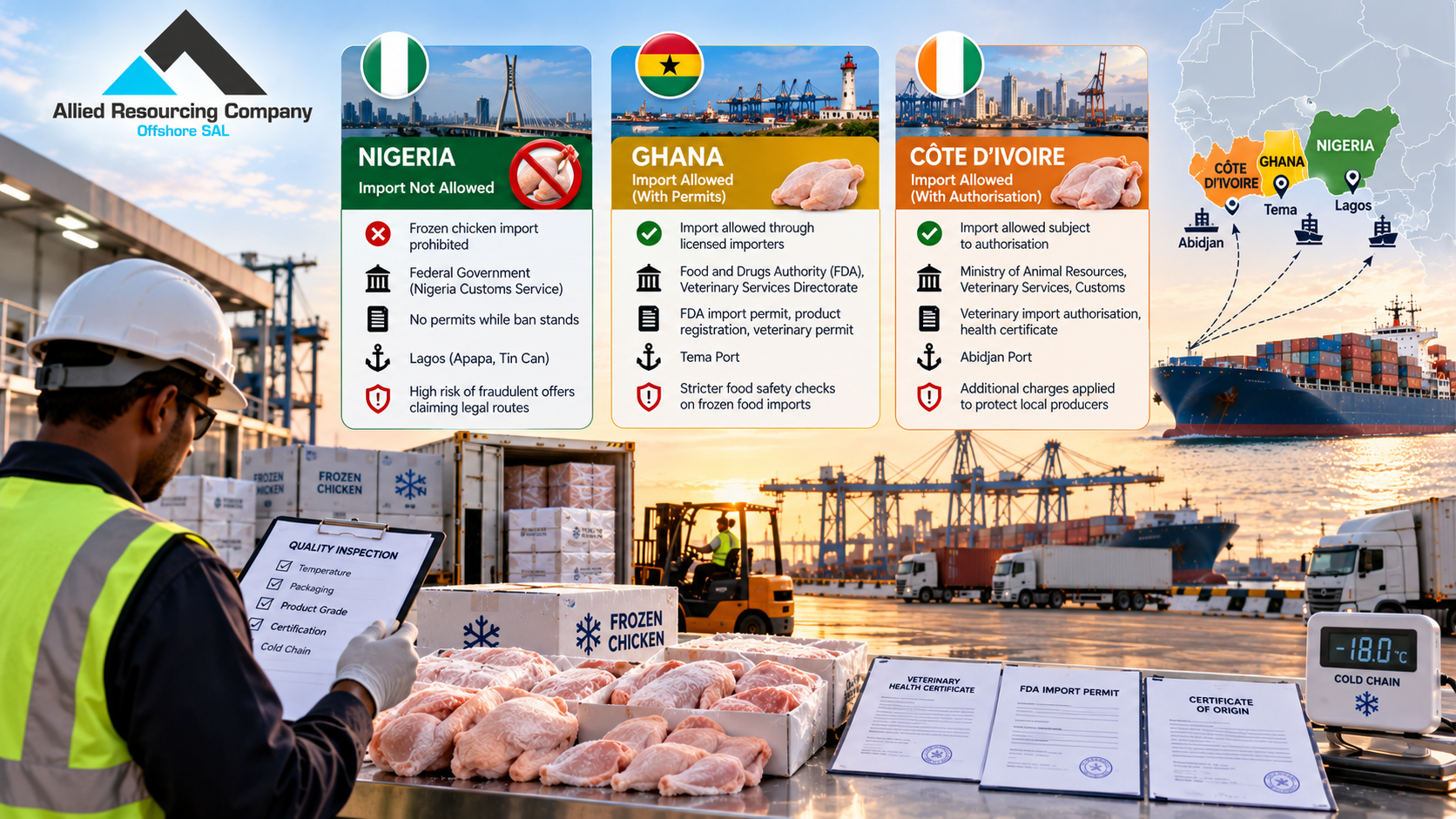
West Africa is often talked about as one market for frozen chicken. It is not. Three neighbouring countries on the same coastline, all members of ECOWAS, have taken three distinct policy paths on poultry imports. One prohibits them. One regulates them closely. One permits them while protecting domestic farmers through cost measures.
For exporters, distributors and buyers, these differences decide whether a deal is possible at all, how much paperwork it needs, and what the landed cost looks like. This guide sets the three countries side by side, then looks at each in turn using the same five questions: Is import allowed? Who regulates it? What documents are needed? Which port handles it? What should buyers watch out for?
Regulations in this sector change, sometimes quickly. Treat this as a framework for asking the right questions, and confirm current rules with your clearing agent and the relevant authority before every new contract.
|
Question |
Nigeria |
Ghana |
Côte d’Ivoire |
|
Is frozen chicken import permitted? |
No, on the import prohibition list |
Yes, through licensed importers |
Yes, subject to authorisation |
|
Main regulatory bodies |
Federal Government trade policy, Nigeria Customs Service |
Food and Drugs Authority (FDA), Veterinary Services Directorate |
Ministry responsible for animal resources, veterinary services, customs |
|
Key permits |
Not applicable while ban stands |
FDA import permit and product registration, veterinary import permit |
Veterinary import authorisation |
|
Main seaport |
Lagos (Apapa, Tin Can) |
Tema |
Abidjan |
|
Policy direction |
Protecting domestic poultry industry through prohibition |
Tighter food safety enforcement, periodic pressure to reduce imports |
Protecting local producers through levies and controls |
|
Biggest buyer risk |
Offers claiming a “legal route” |
Documentation and facility verification failures |
Changing charges affecting landed cost |
No. Nigeria has kept frozen poultry on its import prohibition list for many years as part of a policy to build its domestic poultry industry. The Federal Government’s 2026 fiscal and trade policy announcements kept poultry products among the items that cannot be imported from outside ECOWAS.
Trade policy is set at federal level, and enforcement falls mainly to the Nigeria Customs Service. Because the product is prohibited, there is no permit process to follow.
None will make a frozen chicken import legal while the prohibition stands. Any shipment of frozen poultry arriving at a Nigerian port faces seizure.
Lagos, through the Apapa and Tin Can Island terminals, is Nigeria’s main gateway for food imports in general, but not for frozen chicken under current policy.
The main risk in Nigeria is not regulatory complexity. It is misleading offers. Buyers and investors are sometimes approached with proposals that claim special permits, exemptions or “transit” arrangements that make frozen chicken imports possible. Under current policy, no legal route exists. A responsible supplier will not offer one, and any offer that does should be treated as a serious red flag.
For businesses that want to serve Nigerian consumers, the legitimate opportunities lie elsewhere: other permitted food categories, inputs for the domestic poultry industry such as feed ingredients, and supply to neighbouring markets where imports are allowed.
Yes. Ghana is one of the largest importers of frozen chicken in West Africa, and imported poultry plays a major role in household diets and the food service sector. Ghana’s government has at times signalled a wish to reduce poultry imports and support local producers, and foreign exchange measures in 2022 temporarily restricted access to dollars for poultry imports. Buyers should keep an eye on policy direction.
The Food and Drugs Authority (FDA) regulates food imports, including permits, product registration and inspection. The Veterinary Services Directorate handles animal health requirements. The Ghana Revenue Authority’s customs division manages clearance and duties.
In 2026, the FDA announced tighter enforcement on frozen chicken, meat and fish imports, including mandatory site verification of importers, closer checks that products come from approved hygienic facilities, and stronger documentation requirements to improve traceability.
A typical frozen chicken shipment to Ghana requires:
Tema is the main port for frozen food imports into Ghana, with cold storage facilities in and around the port. Takoradi handles a smaller share of trade.
With the FDA’s 2026 tightening, documentation consistency and facility verification are where shipments are most likely to run into trouble. The plant number on the health certificate must match the plant on the cartons. Product descriptions must match across every document. Importers need their own facilities ready for verification. Remaining shelf life at arrival also matters, so contracts should specify it.
Yes, but under conditions. Côte d’Ivoire has a growing domestic poultry sector, and the government has used measures such as additional levies on imported frozen poultry to protect local producers. These measures affect pricing more than access, but they can change, so landed cost calculations must use current figures.
Veterinary import authorisation is issued by the veterinary services under the ministry responsible for animal resources. Customs handles clearance and the application of duties and any additional charges.
Expect a similar core set to Ghana:
Abidjan is the main port, and one of the busiest in West Africa. It also serves as a gateway for landlocked neighbours such as Burkina Faso and Mali. San Pedro is a secondary port.
The key risk is cost certainty. Additional levies and duties can shift the economics of a shipment, so buyers should confirm current charges before contracting. Labelling language is another practical point: product labelled only in English or Portuguese may need relabelling.
Buyers using Abidjan as a gateway to landlocked markets should also remember that cargo in transit to Burkina Faso or Mali passes through a second set of rules at the destination border. A shipment that clears Abidjan smoothly can still face problems inland if the final market’s veterinary requirements were not checked before loading.
Despite their different policies, the markets where import is permitted share a set of non-negotiable requirements.
Plant-level approval. Destination authorities increasingly look at the specific processing plant, not just the exporting country. Buyers should confirm that the plant producing their order is acceptable to the destination before production starts.
Veterinary health certification. Every shipment needs an official certificate from the exporting country’s competent authority, issued against the specific cargo.
Document consistency. The most common cause of delay is a mismatch between documents: different weights, different product names or different plant numbers. Each mismatch can hold a reefer container at port while storage and power charges grow.
Cold chain integrity. Frozen chicken should be held at -18°C or colder from the processing plant to the cold store. West Africa’s heat makes the port-to-warehouse leg especially sensitive, and temperature records protect the buyer if a dispute arises.
Shelf life at arrival. Authorities and customers pay attention to how much shelf life remains when product lands. Contracts should specify a minimum, because product produced long before shipment can arrive with far less usable life than the buyer expected.
The main exporting origins serving West African markets include Brazil, the United States and the European Union, along with other suppliers depending on price and approval status. Popular products include whole chickens, leg quarters, wings, drumsticks, thighs and other cuts. Each origin and each plant must meet the destination country’s requirements, which is why working with an experienced sourcing partner that knows which plants are accepted in which markets saves time and risk.
For exporters and traders deciding where to focus, a simple framework helps:
ARCOSAL supplies certified frozen chicken cuts, frozen beef and other food commodities to distributors across Africa and the Middle East. We confirm plant approvals for each destination, align documentation across every certificate, arrange independent inspection before loading and coordinate cold chain logistics to ports such as Tema and Abidjan. We only work on routes that are fully legal under destination rules. Learn more about our sourcing and supply chain management approach or visit arcosalbe.com to discuss your requirements.
No. Frozen poultry remains on Nigeria’s import prohibition list, and the 2026 trade policy announcements kept poultry among restricted imports from outside ECOWAS. There is no legal route while the ban stands.
Yes, through licensed importers with FDA permits, veterinary clearance and the correct documentation. The FDA tightened enforcement in 2026, including site verification and stronger traceability checks.
Typically an FDA import permit and product registration where required, a veterinary import permit, a veterinary health certificate, certificate of origin, commercial invoice, packing list and bill of lading, with plant details matching across all documents.
Yes, subject to veterinary authorisation. The government has applied additional levies on imported frozen poultry to support local producers, so buyers should confirm current charges before contracting.
Tema in Ghana and Abidjan in Côte d’Ivoire are the main ports for frozen chicken imports in these markets. Abidjan also serves landlocked neighbours.
Mainly Brazil, the United States and the European Union, with other origins depending on price and plant approval status.
English is generally used in Ghana, while French is expected in Côte d’Ivoire. Confirm exact label content requirements with the importer and authorities.
The most common reasons are document mismatches, plant approval issues, missing permits and short remaining shelf life. Careful preparation before shipment prevents most of them.