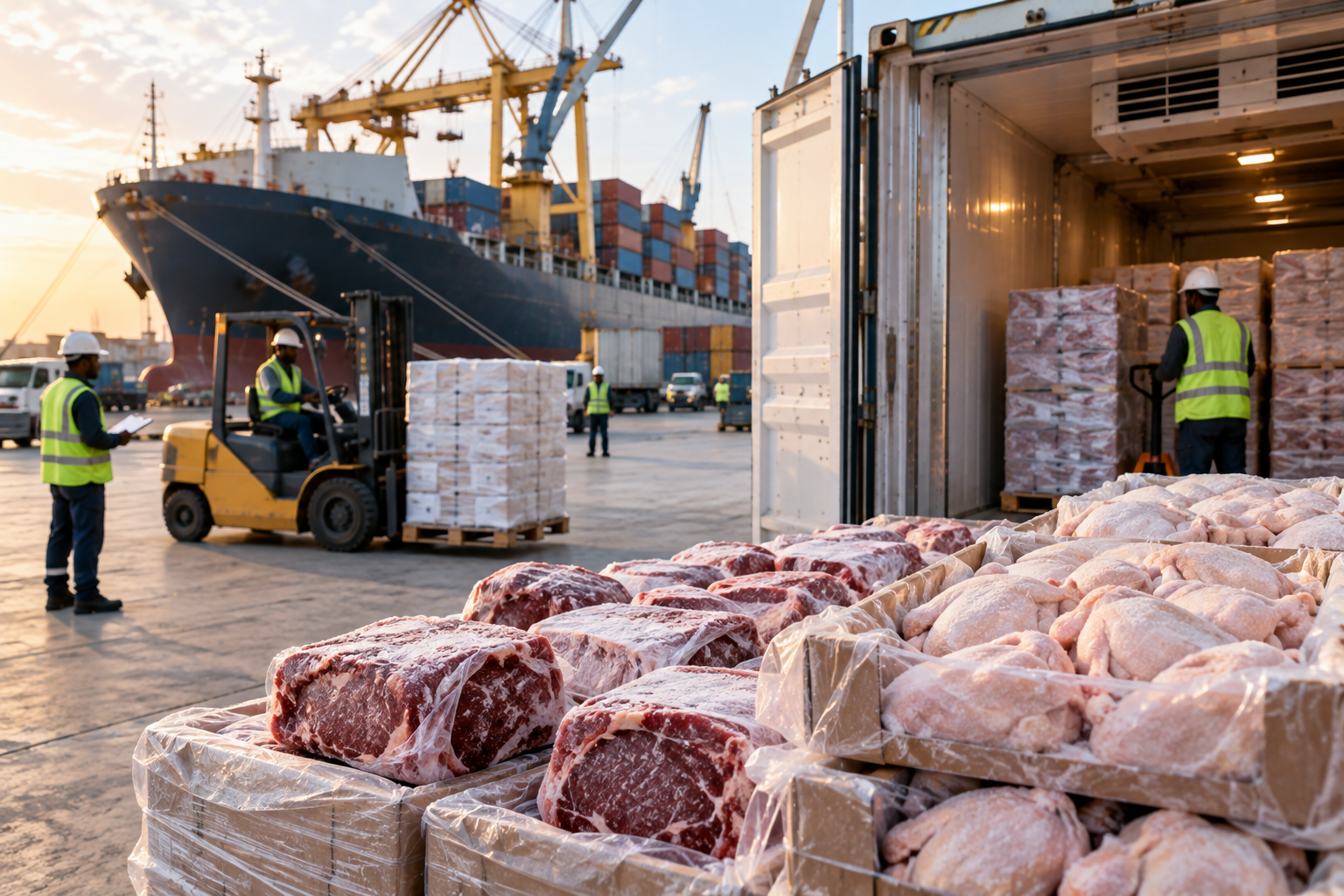
Quick Answer: Businesses importing frozen chicken and beef into Ghana and the wider West African market need a supplier with direct access to certified processing facilities, complete halal and health certification matched to the specific import requirements of each destination country, verified cold chain documentation from processing through to port arrival, and payment structured through Letter of Credit to protect both sides of a Full Container Load transaction.
West Africa's demand for imported frozen chicken and beef has grown steadily for reasons that are structural rather than temporary. Domestic poultry and cattle production across the region has not kept pace with population growth, urbanization, and the expansion of retail and food service infrastructure in cities like Accra, Lagos, and Abidjan. Local farming systems, while active and economically significant, are not currently structured to produce the volume, consistency, or price point that a growing urban consumer base and an expanding retail sector require.
This gap has made frozen chicken supplier Ghana relationships and equivalent import arrangements across neighboring countries a core part of the regional food supply chain rather than a supplementary source. Distributors, retailers, and food service operators across the region depend on a reliable, ongoing supply of imported frozen protein to meet demand that domestic production alone cannot satisfy, and this dependency is expected to deepen rather than reverse as the region's population and urban middle class continue to expand.
Buyers importing frozen meat into this region are not a single uniform group. Understanding the different buyer categories helps clarify what specification, volume, and certification requirements actually matter for a given transaction.
Retail distributors supplying supermarkets and smaller retail outlets typically need consistent piece sizing, attractive packaging suitable for retail display, and halal certification that satisfies both religious requirements for a significant portion of West African consumers and the import documentation standards required by customs authorities in the destination country. Food service operators, including restaurants, catering companies, and institutional buyers, often prioritize cost efficiency and reliable volume over retail packaging presentation, since the product will be processed further before reaching the end consumer. Wholesale traders who redistribute product across multiple smaller buyers need flexibility in container mix, allowing multiple cuts and product types within a single shipment to serve a fragmented downstream customer base efficiently.
A frozen beef importer Ghana relationship built around understanding which of these buyer types a supplier is serving produces a far better commercial outcome than treating every order as an identical bulk transaction with no consideration for how the product will actually move through the local market.
Chicken dominates frozen meat import volume across West Africa, and within chicken, specific cuts see disproportionately strong demand relative to other markets. Chicken feet, wings, and leg quarters move in significant volume across the region, driven by consumer preference, price point relative to breast meat, and suitability for the grilling and stewing preparation styles common in West African cuisine. Whole chicken, sold both as griller-format birds and in larger sizes suited to family and institutional consumption, also represents a substantial share of import demand.
Halal frozen chicken West Africa import volume reflects the significant Muslim population across countries including Nigeria, Ghana's northern regions, and much of the broader Sahel and coastal West African region. Halal certification is not an optional premium feature in this market. For a large share of the consumer base, it is a baseline requirement that determines whether a product can be sold at all in a given retail or food service channel.
Beef import demand, while smaller in overall volume than chicken, is a steady and growing category, with beef cuts including ribs, chuck, brisket, and shank sourced primarily from Brazil and, to a lesser extent, European origins, serving both retail and food service demand across the region's larger urban centers.
Importing frozen meat into Ghana and neighboring West African countries requires documentation that satisfies both the general international standards common to frozen meat trade and specific requirements set by each destination country's food safety and customs authorities.
At minimum, buyers should expect and require a health certificate issued by the exporting country's competent veterinary authority, confirming the product meets the animal health and food safety standards of that origin. A certificate of origin is required to establish the source of the product for customs and trade purposes. Halal certification from a recognized certifying body is essential for the significant share of the market where this is a non-negotiable consumer and regulatory requirement, and buyers should confirm which specific halal certification bodies are recognized by the customs authority in their particular destination country, as recognition can vary between neighboring countries even within the same region.
Import permits and phytosanitary or veterinary import clearance specific to the destination country add another documentation layer that a supplier experienced in this specific trade lane will understand and prepare for proactively, rather than treating West African import documentation as identical to documentation required for other regional markets.
The shipping route and transit conditions for frozen meat moving into West Africa present specific cold chain considerations that buyers should factor into their supplier evaluation. Voyage times from major origin countries including Brazil and parts of Europe to West African ports can extend across several weeks depending on the specific origin and routing, and ambient temperatures at West African ports, particularly during warmer months, place additional strain on cold chain integrity during unloading and onward transport.
A supplier with genuine experience in this specific trade lane manages this by ensuring product loaded with maximum available shelf life, using reefer containers with a strong operational track record on West African routes specifically, and confirming that port handling and onward cold storage arrangements at the destination are adequate before the shipment departs origin. Buyers should ask directly about a prospective supplier's specific experience shipping into West African ports, rather than assuming general frozen meat export experience automatically translates into reliable performance on this particular route.
Frozen chicken and beef pricing for West African import follows the same fundamental structure as international frozen meat trade generally, with FOB and CIF terms determining whether the buyer or supplier arranges and bears the cost of freight and insurance. Given the extended transit times and specific logistics considerations of shipping into West African ports, many buyers in this market, particularly those newer to direct international sourcing, find CIF terms preferable initially because it shifts logistics coordination responsibility to a supplier with established experience on this specific route.
Payment for frozen chicken supplier Ghana and equivalent regional transactions is typically structured through Letter of Credit, which protects the buyer by ensuring payment only releases once the supplier presents shipping and certification documents matching the agreed contract terms, and protects the supplier with a bank-backed payment guarantee once those conditions are satisfied. Given the volume and value typically involved in Full Container Load frozen meat transactions, buyers should treat a supplier's willingness to operate under Letter of Credit terms as a basic indicator of legitimacy rather than an unusual request.
Beyond the general supplier evaluation criteria that apply to any international frozen meat transaction, buyers sourcing for Ghana and the wider West African market should specifically confirm a few additional points before committing to a new supplier relationship.
Confirm the supplier has demonstrable, recent experience shipping frozen chicken or beef specifically into your destination country or a closely comparable regional port, not just general export experience to unrelated markets. Verify that the halal certification the supplier provides is recognized by your specific destination country's customs and food safety authority, since certification recognition is not automatically uniform across the region. Request references from other buyers actively importing into West Africa, since a supplier's performance on this specific route is a more relevant indicator than performance on entirely different trade lanes. Confirm the supplier understands the import permit and clearance process specific to your country, as procedural requirements and processing timelines vary meaningfully between neighboring West African markets.
Why does West Africa import such a large volume of frozen chicken and beef?
West Africa imports significant volumes of frozen chicken and beef because domestic poultry and cattle production has not kept pace with population growth, urbanization, and the expansion of retail and food service infrastructure across major cities in the region, creating a structural dependency on imported frozen protein.
What is the difference between FOB and CIF terms for frozen meat imports into Ghana?
Answer: FOB terms mean the buyer arranges and pays for freight and insurance once the product is loaded at the origin port, while CIF terms mean the supplier arranges and includes shipping and insurance costs in the quoted price through to the destination port, with CIF often preferred by buyers newer to direct international frozen meat sourcing.
Which chicken cuts see the highest import demand across the West African market?
Answer: Chicken feet, wings, and leg quarters see particularly strong demand across West Africa due to consumer preference, favorable price point relative to breast meat, and suitability for regional cooking styles, alongside steady demand for whole chicken in both griller and larger family-size formats.
How long does frozen meat typically take to ship from major origin countries to West African ports?
Answer: Transit times from major origin countries including Brazil and parts of Europe to West African ports can extend across several weeks depending on the specific origin and shipping route, making cold chain integrity and available shelf life at time of loading particularly important considerations for this trade lane.
What payment method is standard for frozen chicken supplier Ghana transactions?
Answer: Letter of Credit is the standard payment instrument for frozen chicken and beef import transactions into Ghana and the wider West African market, providing payment security for the buyer while giving the supplier a bank-guaranteed payment mechanism once correct shipping and certification documents are presented.
ARCOSAL, Allied Resourcing Company Offshore S.A.L., sources a full range of frozen chicken cuts and beef products from certified processing facilities across Brazil and Europe, and as we extend our sourcing and supply chain services to buyers across Ghana and the wider West African market, our approach is built around understanding the specific certification, documentation, and logistics requirements of this particular trade lane rather than applying a generic export process across every destination.
Every shipment we coordinate includes complete halal and health certification matched to the requirements of the destination market, verified cold chain documentation, and product specification confirmation before loading. You can learn more about how we manage sourcing and supply chain solutions across the regions we serve on our Sourcing and Supply Chain page.
If your business is importing frozen chicken or beef into Ghana or elsewhere across West Africa and needs a sourcing partner who understands this specific market's certification and logistics requirements, we are ready to discuss your requirements.
Contact the ARCOSAL team at Info@arcosalbe.com or visit arcosalbe.com to discuss your frozen meat sourcing needs for Ghana and West Africa.