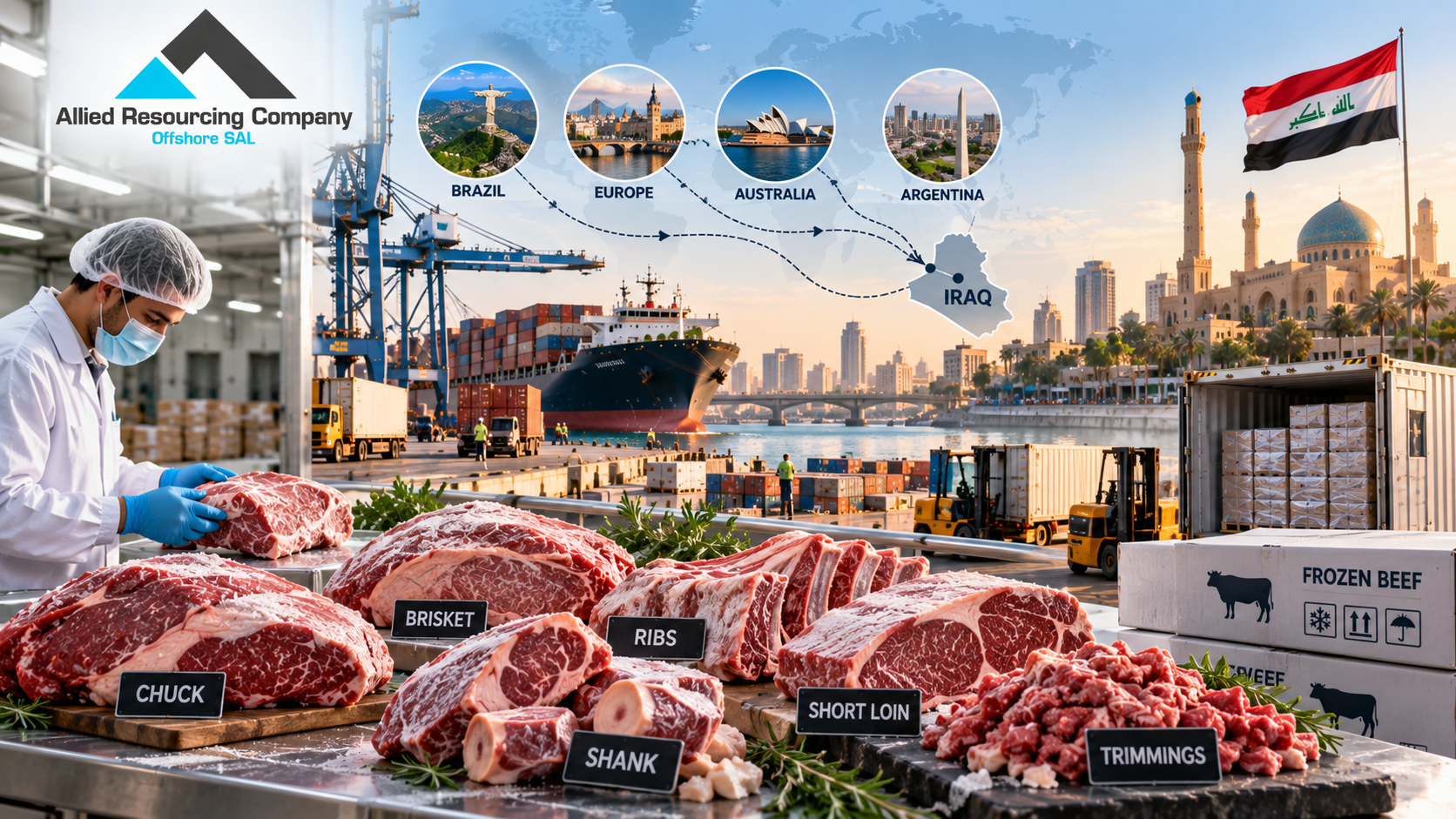
Iraq is one of the most active frozen beef import markets in the Middle East, and it is not hard to see why. Domestic cattle production does not meet demand, food service is expanding in Baghdad, Basra and Erbil, and beef is part of everyday cooking. For distributors and wholesalers, that means steady volume. It also means competition, tight margins and very little room for a container that arrives with the wrong cut, the wrong paperwork or a plant that is not approved.
This guide is written for buyers who already know the market but want a clearer framework for sourcing frozen beef for Iraq: which origins to consider, which cuts move, and exactly what needs to be written into a purchase specification before a supplier is asked to quote.
Origin is the first decision, and it shapes price, available cuts, transit time and the documentation a buyer will receive. There is no single best origin. There is only the best fit for a given customer and price point.
Brazilian frozen beef is the backbone of supply into Iraq and much of the region. Brazil has a very large export industry, a wide range of plants approved for Middle Eastern markets, and the ability to supply both forequarter and hindquarter cuts at competitive prices. Its plants are experienced with the slaughter certification and documentation the region requires.
The trade-offs are transit time, which is long, and variation between plants. Two Brazilian suppliers can deliver noticeably different products under the same cut name, which is why the plant matters as much as the country, and why working with an experienced sourcing partner who knows each plant’s track record makes a real difference.
European beef, from origins such as Ireland, Poland and others, is typically positioned at a higher price point. Buyers choose it for consistency, specific cuts, and shorter transit compared with South America. European supply suits hotels, restaurants and premium retail more than price-led wholesale.
Australian beef carries a strong reputation for quality and food safety systems. Grain-fed and grass-fed options give buyers flexibility on eating quality. Price and freight costs usually place it above Brazilian products, so it tends to serve customers who specifically ask for it.
Argentina, Uruguay and Paraguay all export frozen beef. Availability into Iraq depends on plant approvals and market conditions, so check these origins case by case.
|
Factor |
Brazil |
Europe |
Australia |
|
Typical price position |
Competitive |
Higher |
Higher |
|
Range of approved plants |
Wide |
Moderate |
Moderate |
|
Transit time to Umm Qasr |
Long |
Shorter |
Long |
|
Best suited to |
Wholesale, retail, processing |
Premium retail, HORECA |
Premium HORECA, specific customer demand |
Treat the table as a starting point. Freight, exchange rates and plant availability change from quarter to quarter.
Understanding demand by cut is where many new importers lose money. A container of the wrong mix sits in cold storage while competitors sell what the market actually wants.
Chuck is a workhorse cut for Iraqi kitchens. It suits slow cooking, stews and minced preparations, and it sells across retail and food service.
Brisket works well for braising and is popular with butchers who portion it further for retail customers.
Shank is valued for bone-in cooking and soups, and it is a common component of mixed containers.
Beef trimmings are sold by lean percentage, often expressed as a ratio such as 80/20 or 90/10 lean to fat, and they feed the mince, kebab and processing trade. For many Iraqi distributors, trimmings are among the fastest moving lines.
Short loin and related premium cuts go to hotels, restaurants and higher end retail. Volumes are smaller, margins are better, and specification requirements are stricter.
Ribs suit both food service and retail depending on how they are cut and packed.
Most distributors do not buy a full container of a single cut. A typical approach combines a large share of fast moving forequarter cuts and trimmings with a smaller share of premium cuts for specific customers. Review the ratio after every container rather than repeating the last order out of habit.
This is the section that matters most. A supplier can only deliver what the buyer has defined. Everything left vague will be interpreted in the supplier’s favour when there is a dispute.
Name the cut clearly, and where possible use a recognised specification such as the supplier’s own cut code alongside a plain description. “Beef chuck” alone is not a specification. State whether it is boneless or bone-in, how it is trimmed, and the acceptable piece size range.
For trimmings, state the lean percentage and the testing method.
Ask for the specific plant number or plant numbers that will produce the order, and confirm that each plant is approved for export to Iraq. A legitimate supplier can still ship from the wrong plant, and a plant approval problem at Umm Qasr is one of the most expensive mistakes an importer can make. Proper supplier and facility qualification before the order is placed removes this risk.
Specify the slaughter certification required for Iraq and the certifying body that will issue it. The certificate must match the plant and the production dates on the cartons.
Define the net weight per carton, the packaging format such as vacuum packed primals inside cartons, and whether pieces are individually wrapped.
State the maximum fat cover for each cut. This single line prevents a common complaint where a cut technically matches its name but carries far more fat than the buyer expected.
Arabic labelling is generally expected for product entering the Iraqi market. Specify what the carton label must show, including product name, origin, plant number, production date, expiry date and net weight, and in which languages.
Frozen beef carries a long shelf life, but Iraqi buyers and authorities pay close attention to the remaining shelf life at arrival. State a minimum remaining shelf life on arrival at destination, not just at production. Product produced long before shipment can arrive with far less usable life than the buyer assumed.
Specify the required core temperature at loading and the reefer setting for the voyage, and require temperature logs from loading through to discharge.
Name an independent inspection company to check the cargo before loading, and make their certificate a condition of payment if trading on a Letter of Credit.
The main maritime gateway for frozen food into Iraq is Umm Qasr port near Basra. Cargo is then moved by refrigerated truck to cold stores in Basra, Baghdad and other cities. Some cargo bound for the Kurdistan Region travels overland through neighbouring countries, which changes the route, the transit time and sometimes the documentation. Buyers should agree the route before ordering, because it affects the Incoterm, the freight cost and the cold chain plan.
A standard frozen beef shipment into Iraq will typically include the commercial invoice, packing list, bill of lading, certificate of origin, a veterinary health certificate issued by the competent authority in the origin country, and the slaughter certificate. Requirements can be updated by Iraqi authorities, so buyers should confirm the current list with their customs broker before each new origin or product is introduced.
The most common documentation problems are simple: a plant number that differs between the health certificate and the cartons, product descriptions that do not match across documents, and documents that arrive after the vessel. Each of these can hold a reefer container at port while storage and power charges accumulate.
Iraq’s summer heat makes the leg from port to cold store especially sensitive. A container that waits too long on the quay or travels in a truck with weak refrigeration can lose quality quickly. Pre-booked transport and receiving capacity at the cold store reduce that risk.
Most frozen beef imports into Iraq from established exporters are traded on a documentary Letter of Credit or on structured advance and balance terms. A Letter of Credit protects both sides when the document list is written carefully, and it allows the inspection certificate to be built into the payment conditions.
On Incoterms, CFR and CIF to Umm Qasr are common because many buyers prefer the seller to arrange the ocean freight. If CIF is chosen, specify the insurance cover. Minimum cover often excludes temperature deviation, which is the risk that matters most for reefer cargo.
ARCOSAL works as an offshore purchasing department for distributors who want reliable supply without building a sourcing team at every origin. That means qualifying plants for Iraqi approval, agreeing the specification in writing, arranging pre-shipment inspection, preparing consistent documentation and coordinating cold chain logistics to Umm Qasr and onward. Learn more about our sourcing and supply chain management approach, or contact the team to discuss your next container.
Brazil is one of the most important suppliers of frozen beef to Iraq and the wider Middle East, thanks to its large export industry, wide range of approved plants and competitive pricing. Europe and Australia supply smaller volumes, usually at higher price points.
Forequarter cuts such as chuck, brisket and shank, along with beef trimmings for mince and processing, are among the fastest moving lines. Premium cuts such as short loin are sold mainly to hotels, restaurants and higher end retail.
Typically a commercial invoice, packing list, bill of lading, certificate of origin, veterinary health certificate from the origin country, and slaughter certificate. Buyers should confirm current requirements with a customs broker before each shipment.
Umm Qasr port near Basra is the main maritime entry point for frozen food. Some cargo for the Kurdistan Region arrives overland through neighbouring countries.
Approvals are often granted at plant level. A reliable supplier can still load cargo from a plant that is not approved for Iraq, and that cargo can be refused at the port. Always confirm the specific plant number before ordering.
Buyers should specify a minimum remaining shelf life at arrival in Iraq, not just at production. The exact figure depends on the distributor’s sales cycle and customer requirements, but it should be written into the contract.
Both are common. Under either term, risk passes to the buyer when the cargo is loaded at origin. If buying CIF, specify the insurance cover so that temperature deviation is included.
Yes. Mixed containers are common, combining fast moving forequarter cuts and trimmings with a smaller share of premium cuts. Agree the mix, carton weights and labelling for each cut in the specification.