Diesel keeps West Africa moving. It runs the trucks that carry goods inland from Tema and Lomé, the generators that back up unreliable grid power, the mining equipment in Ghana’s gold belt, the construction machinery on new roads and the farm equipment across the Sahel. For businesses that consume or distribute it, bulk diesel supply is not a background cost. It is an operational lifeline.
This article is a briefing for bulk fuel buyers in West Africa: distributors, mining and construction companies, industrial users and traders who want to understand EN590 diesel, how supply reaches the region, what the rules are, and how to tell a real offer from a dangerous one.
EN590 is published by the European Committee for Standardization and sets the minimum requirements for diesel used in road vehicles. It covers far more than sulphur. The parameters buyers most often check are summarised below.
|
Parameter |
EN590 Requirement |
Why It Matters |
|
Sulphur |
Maximum 10 mg/kg |
Protects engines and emission systems, reduces pollution |
|
Cetane number |
Minimum 51 |
Ignition quality, smooth starting and combustion |
|
Density at 15°C |
820 to 845 kg/m³ |
Energy content and consistency |
|
Flash point |
Above 55°C |
Safety in storage and handling |
|
FAME (biodiesel) content |
Maximum 7% by volume |
Blending limit for biodiesel |
|
Water content |
Strict maximum |
Prevents corrosion and microbial growth |
|
Cold filter plugging point |
Set by climate class |
Cold weather performance, less relevant in West Africa |
A proper quality certificate also reports distillation range, lubricity and oxidation stability.
West African countries set their own national fuel specifications. Under a regional agreement, ECOWAS member states committed to a maximum sulphur level of 50 ppm for imported diesel, a major improvement on the much higher limits that applied for years. Ghana was among the countries that moved early to the 50 ppm limit.
This means EN590 diesel at 10 ppm comfortably meets the sulphur requirement, but buyers should still check the full national specification, because other parameters such as density range and flash point can differ slightly from EN590. The cargo must satisfy the destination country’s standard, whatever it is called on the supplier’s offer sheet.
Even where local rules allow 50 ppm, many buyers ask for EN590. Mining companies and fleet operators running modern engines prefer the lowest sulphur fuel to protect equipment and meet the standards of their international owners or lenders.
For decades, West Africa relied heavily on imported refined products, even in oil producing countries, because local refining capacity was limited or operating below potential. Diesel arrived mainly from European refineries, through trading hubs such as the Amsterdam Rotterdam Antwerp region, and from other refining centres serving the Atlantic basin.
That picture is changing. New refining capacity in Nigeria has begun supplying refined products domestically and to neighbouring markets, and governments across the region are pursuing more local refining. For buyers, this means more supply options, but also a market where trade flows and pricing relationships are shifting. Good sourcing now requires up to date market knowledge, which is where an experienced bulk fuel sourcing partner adds value.
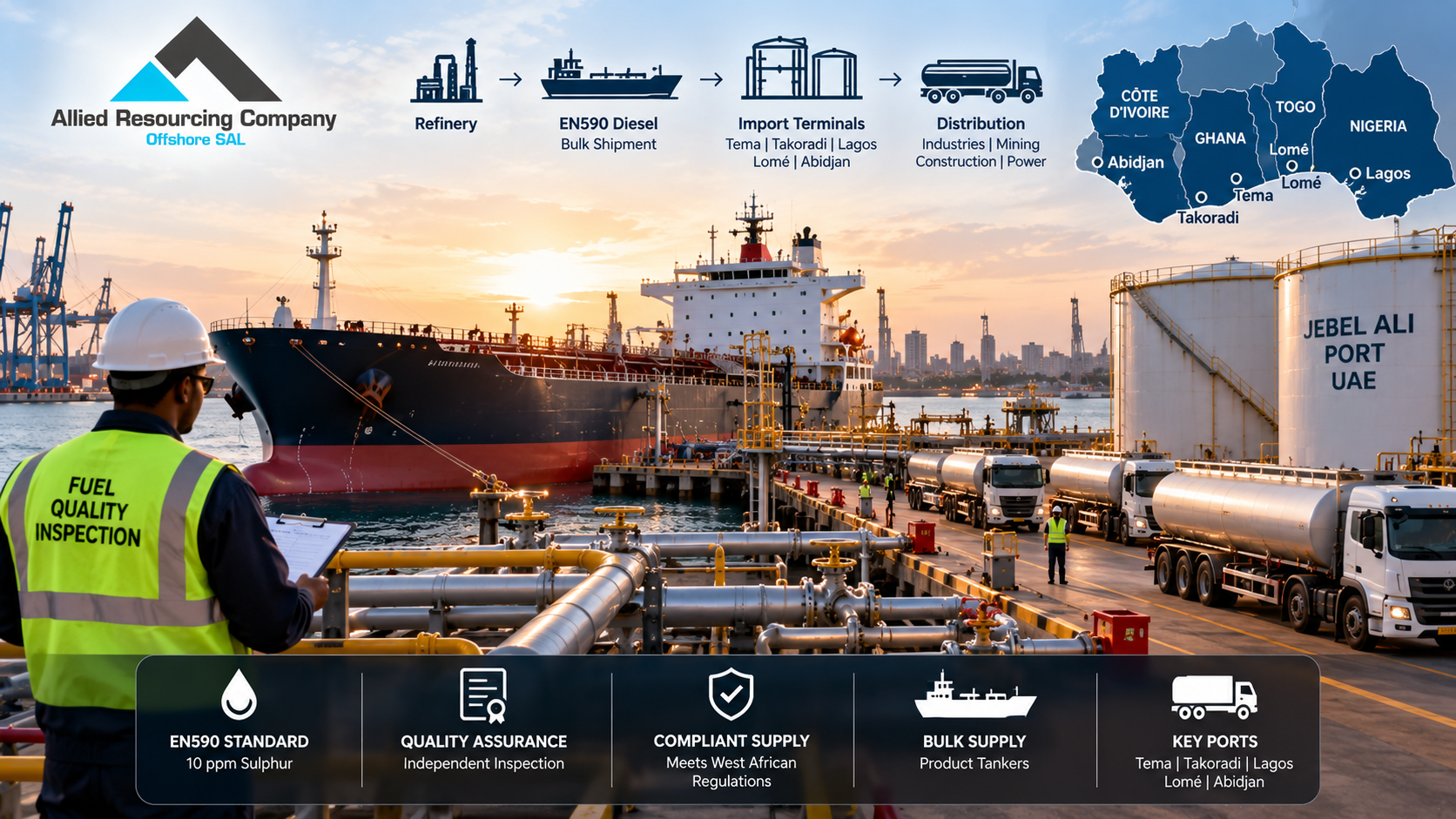
Lomé in Togo has long served as a storage and transshipment point for products moving along the coast. Tema and Takoradi handle Ghana’s imports. Lagos is the gateway to Nigeria’s large market. Abidjan serves Côte d’Ivoire and landlocked neighbours to the north. Product often arrives on larger tankers and is redistributed on smaller vessels to ports with draft or storage limits.
In most West African countries, only licensed entities can import petroleum products. In Ghana, imports are handled by Bulk Distribution Companies licensed by the National Petroleum Authority. Other countries have their own regulators and licensing systems.
For an end user such as a mining company, this usually means buying from or through a licensed importer rather than importing directly. For a foreign supplier, it means a sale must be structured around a licensed local counterparty. Any offer that ignores this is either incomplete or not genuine.
National authorities typically test imported diesel before it can be discharged into storage or released to the market. Cargo that fails the national specification can be rejected, which is an expensive outcome for everyone involved. This is another reason to insist on testing at loading, so problems are identified before the vessel sails.
Several West African countries regulate fuel pricing through formulas, margins or price bands, and apply levies and taxes at import. These rules change periodically and affect what a local buyer can pay and resell at.
International diesel cargoes are usually priced against a published benchmark for a defined period, such as an average around the bill of lading date, plus or minus a differential. The differential reflects freight, quality, the size of the cargo and market conditions. Buyers should understand both parts: the benchmark moves with global markets, while the differential is where negotiation and supplier quality show up.
Most bulk diesel into West Africa moves on CIF or CFR terms to a named discharge port, or FOB at the loading port for buyers who charter their own vessels. Delivery can also be arranged ex-tank from storage in a regional hub. The Incoterm decides who arranges the vessel and insurance and when risk passes, so it should be agreed with the logistics plan in mind.
Product tankers commonly carry cargoes in the tens of thousands of tonnes. Smaller buyers often access supply through distributors or by taking part cargoes. Quantity tolerances, usually expressed as a plus or minus percentage, should be written into the contract.
Established trades commonly use a documentary Letter of Credit or a standby Letter of Credit, with payment against shipping documents and independent inspection reports. These instruments protect both sides through the banking system. Payment structures that require the buyer to send money before any verifiable cargo or document exists remove that protection.
The diesel trade attracts fraud because the sums are large and many buyers are new to international petroleum procedures. Fraudulent offers often look professional and use real company names and industry terminology. Knowing the pattern is the best defence.
A legitimate supplier will welcome this process. Resistance to it is itself a warning sign.
An independent inspector samples the product from shore tanks and vessel tanks, tests it against the specification and measures the quantity. The certificate of quality and certificate of quantity become key shipping documents.
The destination authority and an independent inspector sample and test again. Quantity is measured in shore tanks and compared with the bill of lading figure. Small differences are normal and should be covered by agreed tolerances. Larger differences need investigation and, where justified, a claim.
From import terminals, diesel moves by road tanker to depots, mines, construction sites and inland markets, including landlocked neighbours. Storage capacity and inland transport often limit how quickly a cargo can be absorbed, so buyers should plan offtake before the vessel arrives.
ARCOSAL supplies EN590 diesel, jet fuel, D6, crude oil, bitumen and other energy products to buyers across Africa and the Middle East. Our approach is built on verified sources, independent inspection, transparent documentation and payment structures that protect both sides. We work with licensed local partners to keep every transaction compliant with national rules. Learn more about our sourcing and supply chain management approach, or visit arcosalbe.com to discuss your fuel requirements with our team.
EN590 is the European standard for automotive diesel. It sets requirements for sulphur, cetane number, density, flash point, biodiesel content and other parameters. Its sulphur limit is 10 mg/kg, often called 10 ppm ultra low sulphur diesel.
On sulphur, yes. ECOWAS countries adopted a 50 ppm maximum for imported diesel, and EN590 at 10 ppm is well below that. Buyers should still check each country’s full national specification for other parameters.
Diesel imports into Ghana are handled by Bulk Distribution Companies licensed by the National Petroleum Authority. End users usually buy from or through these licensed companies.
Major ports include Tema and Takoradi in Ghana, Lagos in Nigeria, Lomé in Togo and Abidjan in Côte d’Ivoire. Lomé is also widely used as a storage and transshipment point.
Usually against a published international benchmark for an agreed pricing period, plus or minus a differential that reflects freight, quality, cargo size and market conditions.
Be cautious of offers far below market price, requests for upfront fees, unverifiable documents and refusal of independent inspection. Verify companies, terminals, vessels and inspection reports directly with the source, and use bank-backed payment structures.
Independent inspection confirms quality and quantity at loading and discharge. It protects the buyer against off-specification products and short delivery, and it provides evidence if a claim is needed.
Yes, usually through licensed distributors, part cargoes or ex-tank purchases from regional storage, rather than full tanker cargoes.