Copper and aluminium sit at the heart of modern industry. Copper carries electricity through cables, motors, transformers and electronics. Aluminium builds lighter vehicles, aircraft, window frames, packaging and power lines. As the world electrifies and builds new infrastructure, demand for both metals keeps growing, and so does the importance of the trading hubs that connect producers to manufacturers.
The UAE is one of those hubs. Metal from South America, Africa, Central Asia and the Gulf itself moves through UAE ports, warehouses and trading companies on its way to manufacturers in the Middle East, South Asia, Africa and beyond. This guide explains how sourcing copper cathodes and aluminium ingots through the UAE works, what buyers should specify, and how to protect themselves in a market where the value of a single container makes verification essential.
|
Copper Cathodes |
Aluminium Ingots |
|
|
What it is |
Refined copper plates produced by electrolytic refining or SX-EW |
Cast blocks of primary aluminium produced by smelting |
|
Common grade |
Grade A, minimum 99.99% Cu |
P1020A, minimum 99.7% Al |
|
Key standards |
BS EN 1978 (Cu-CATH-1), ASTM B115 |
LME P1020A specification |
|
Main uses |
Wire rod, cables, electrical equipment, tubes |
Extrusions, castings, rolling, alloys |
|
Typical packing |
Strapped bundles of cathode sheets |
Strapped bundles of stacked ingots |
|
Pricing basis |
LME copper plus or minus premium |
LME aluminium plus or minus premium |
|
Major origins |
Chile, Peru, DRC, Zambia and others |
Gulf producers including the UAE, plus other global smelters |
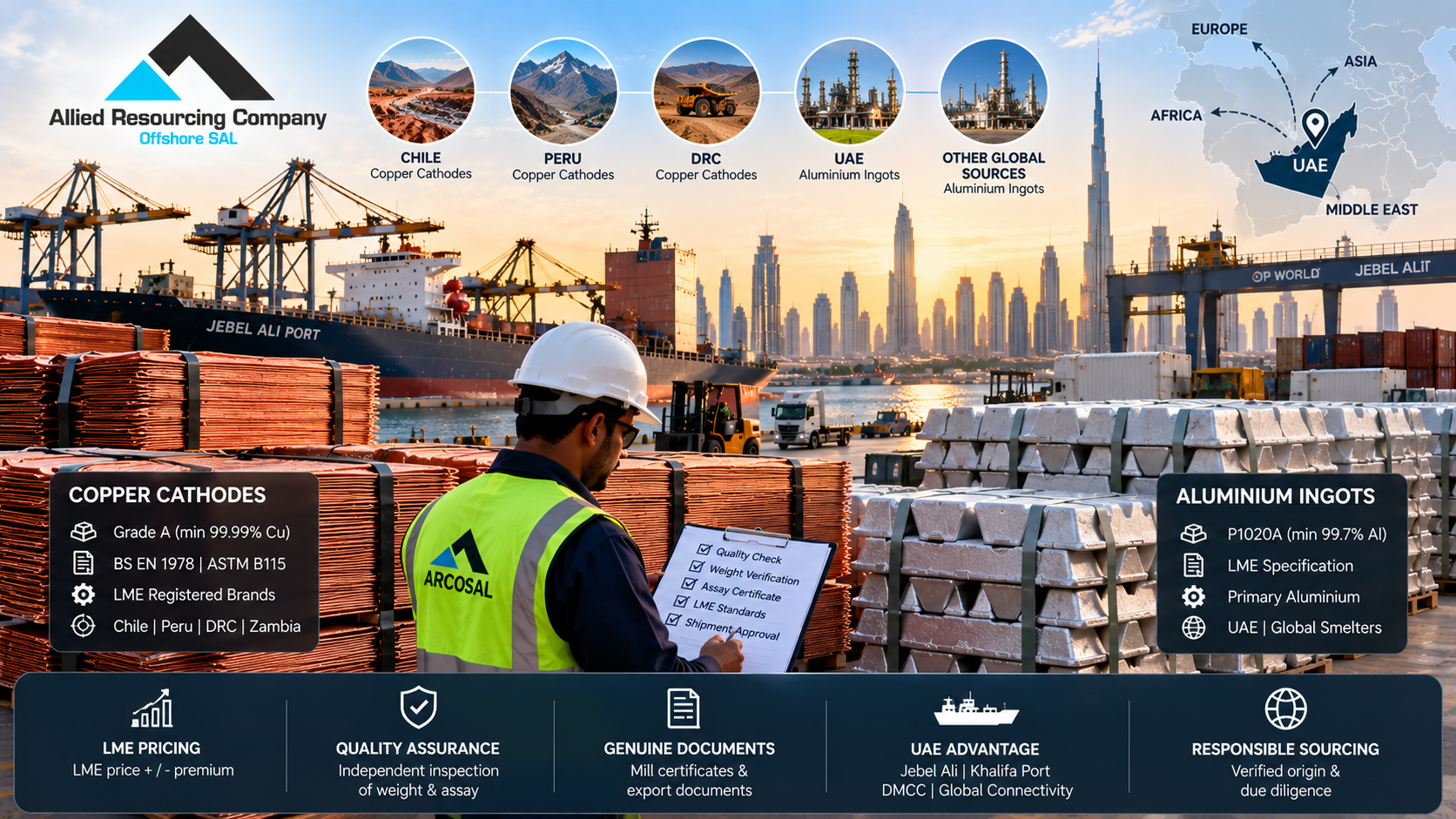
Grade A copper cathode is the benchmark product for industrial buyers. It contains at least 99.99% copper, with strict limits on impurities such as silver, sulphur, iron, lead and selenium. Specifications are defined under standards such as BS EN 1978 Cu-CATH-1 and ASTM B115. Cathodes from brands registered with the LME meet the exchange’s quality requirements, which gives buyers an extra layer of confidence.
Lower grades exist and have their uses, but they must be priced and described honestly. A common problem in the trade is lower purity material offered as Grade A.
Chile and Peru are among the world’s largest copper producers. The Democratic Republic of the Congo and Zambia in Africa’s Copperbelt are also major sources, and their output is increasingly important to global supply. Copper cathodes from these and other origins reach the UAE for storage, onward trade and supply to regional manufacturers.
Copper from some regions carries elevated risk of links to human rights abuses, poor working conditions or conflict. Many industrial buyers, especially those supplying international customers, now require evidence of responsible sourcing in line with recognised due diligence guidance, such as the OECD framework. Ask the supplier how the material’s origin and chain of custody are documented.
P1020A is the most widely traded primary aluminium ingot grade, with a minimum of 99.7% aluminium and maximum limits on silicon and iron. It is the standard grade for LME aluminium contracts. Higher purity grades exist for specialised applications. Buyers in extrusion, casting and rolling usually specify P1020A unless their process requires something else.
Primary aluminium, made from alumina in a smelter, is different from secondary aluminium, made from recycled scrap. Both have markets, but they are not interchangeable, and the difference must be clear in the contract.
The Gulf is home to some of the world’s largest aluminium smelters. The UAE itself is a major producer, which makes it not only a trading hub but also a source of primary aluminium. Regional production supports shorter supply chains for manufacturers in the Middle East and nearby markets.
Location. The UAE sits between producing regions in Africa, the Gulf and Asia and consuming markets across the Middle East, South Asia and East Africa.
Ports and logistics. Jebel Ali and Khalifa Port offer extensive container and breakbulk capacity, warehousing and connections to major shipping routes.
Free zones. The Dubai Multi Commodities Centre (DMCC) is one of the world’s best known commodity trading free zones, home to a large community of metals traders. Free zone structures allow storage and re-export with efficient customs handling.
Finance. The UAE’s banking sector supports trade finance instruments such as Letters of Credit, which are central to safe metals trading.
Regulation and reputation. UAE authorities have strengthened anti-money laundering and due diligence rules in recent years. For buyers, this means counterparties are increasingly expected to meet higher compliance standards.
The buyers sourcing copper and aluminium through the UAE are a varied group. Cable and wire manufacturers in the Gulf, South Asia and East Africa need steady supplies of copper cathode for wire rod production. Aluminium extruders making window frames, curtain walls and construction profiles rely on ingot supply for the region’s building projects. Foundries and die casters serving the automotive and engineering sectors buy ingots and alloys. Electrical equipment makers use copper for transformers, switchgear and motors. And trading companies buy for onward sale into markets where direct relationships with producers are harder to establish. Each group has different volume patterns, quality priorities and payment practices, which a good supplier will understand.
Copper cathodes and aluminium ingots usually move in 20 foot containers or as breakbulk cargo on larger shipments. Metal is dense, so containers reach their weight limit long before they are full. Bundles should be strapped securely, clearly marked with brand, lot and weight, and kept dry, since moisture can stain cathode surfaces. For metal held in UAE warehouses, buyers should confirm that the warehouse is reputable, that stock is identified by lot, and that release documents are verified with the operator before payment.
Understanding how a legitimate transaction flows makes it easier to spot one that does not.
The value of industrial metals makes them a target for fraud. Common schemes include fake warehouse receipts, cargo that does not exist, cathodes replaced with lower grade material, and bundles that contain painted or substituted metal. These checks protect buyers.
|
Risk |
What to Check |
|
The seller is not who they claim |
Verify company registration and directors directly with the registry. Check trading references independently. |
|
The metal does not exist |
Confirm the cargo or warehouse stock directly with the warehouse operator or shipping line, using contact details you source yourself. |
|
Grade is lower than stated |
Require independent sampling and assay by a recognised inspection company. |
|
Brand is misrepresented |
For LME brands, verify the brand against the LME’s published list and check markings on the metal. |
|
Weight is short |
Independent weighing at loading or warehouse release. |
|
Documents are forged |
Verify mill certificates, inspection reports and warehouse receipts directly with their issuers. |
|
Payment risk |
Use bank-backed instruments. Never send large advance payments to unverified counterparties. |
Be especially cautious with offers well below the LME price, requests for upfront fees, pressure to pay before inspection, and sellers who will not allow independent verification. In metals, as in fuel, a price that looks too good is usually the clearest warning sign.
For copper cathodes:
For aluminium ingots:
Both metals are usually priced against the LME official price, averaged over an agreed period, such as the month of shipment. On top of this, a premium or discount reflects location, brand, delivery timing, freight and regional supply and demand. Premiums can vary meaningfully between regions and over time, so two offers with the same LME basis can still differ in final cost.
Buyers who understand both components can compare offers fairly and recognise when a quoted price simply does not make sense against the market.
ARCOSAL supplies copper cathodes, copper ore, aluminium ingots, iron ore, lithium and other minerals to industrial buyers in the Middle East, Africa, Asia and Europe. Our approach puts verification first: qualified producers, independent inspection of weight and assay, documents verified with their issuers, responsible sourcing checks and bank-backed payment structures. Learn more about our sourcing and supply chain management model, see how we act as an offshore purchasing department in our supply chain services, or visit arcosalbe.com to discuss your metals requirements.
Grade A copper cathode is refined copper with a minimum of 99.99% copper content, produced to standards such as BS EN 1978 Cu-CATH-1 or ASTM B115. It is the main grade used by wire rod and cable manufacturers.
P1020A is the standard primary aluminium ingot grade, with a minimum of 99.7% aluminium and limits on silicon and iron. It is the grade used for LME aluminium contracts.
The UAE combines a strategic location, major ports such as Jebel Ali and Khalifa Port, free zones such as DMCC, strong trade finance and its own large aluminium industry.
Usually against the London Metal Exchange official price over an agreed period, plus or minus a premium that reflects location, brand, timing and regional market conditions.
Use independent sampling and assay by a recognised inspection company, check brand markings against the LME’s list of registered brands, and verify mill certificates directly with the producer.
Prices well below the LME level, requests for upfront fees, refusal of independent inspection, documents that cannot be verified with their issuers and pressure to pay quickly.
Primary aluminium is produced from alumina in a smelter. Secondary aluminium is produced from recycled scrap. Both are traded, but they differ in composition and price and must be clearly described in contracts.
Increasingly, yes. Many buyers require evidence that copper was sourced in line with recognised due diligence frameworks, especially for material from higher risk regions.