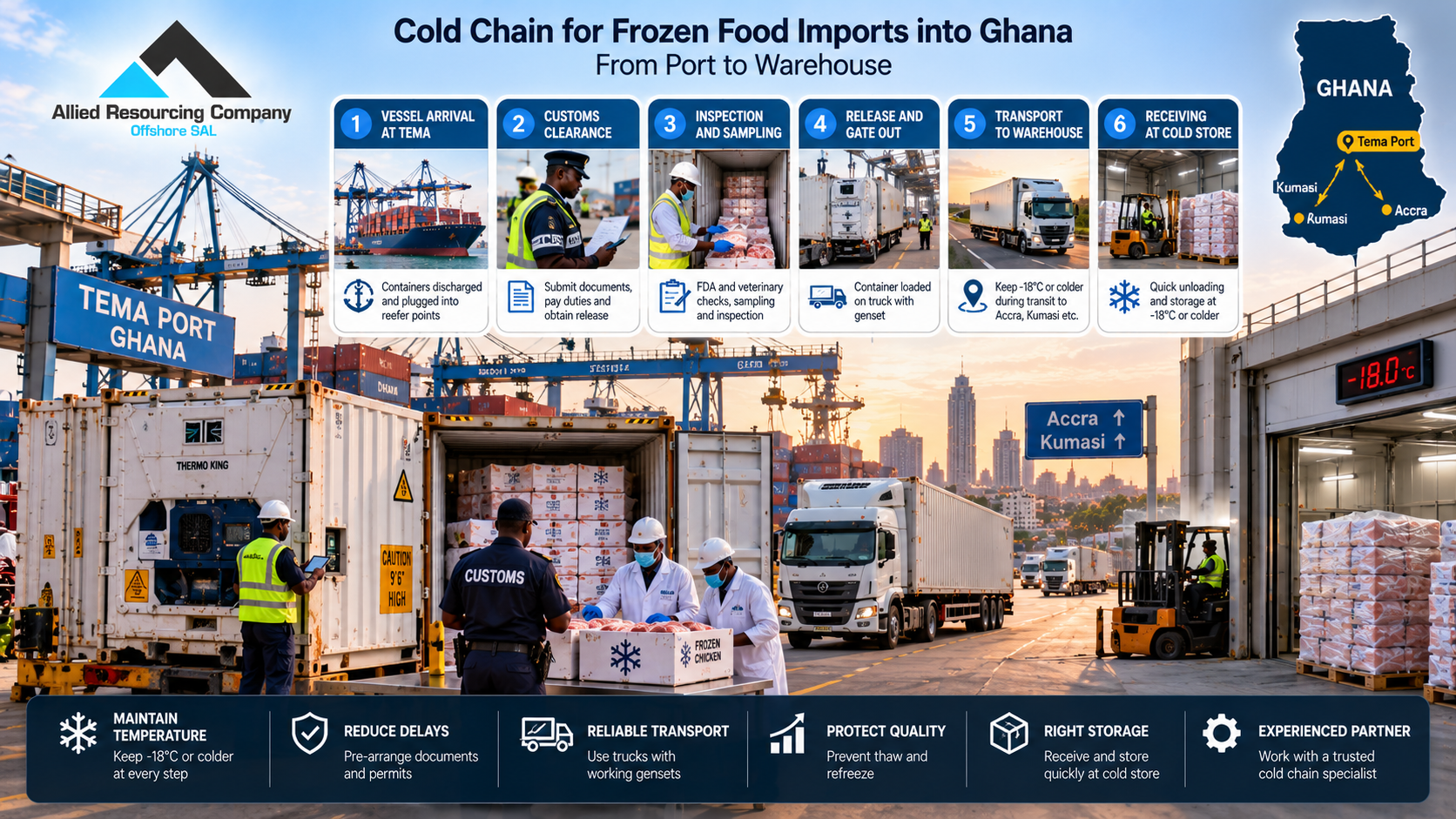
A reefer container of frozen chicken leaves Brazil at -18°C. It crosses the Atlantic for weeks, plugged into the ship’s power supply, holding temperature perfectly. Then it arrives in Tema. Within a few days, depending on how the next steps are handled, that same container can either reach the importer’s cold store in excellent condition or arrive with partially thawed cartons, stained packaging and a quality claim that nobody can win.
The final stretch, from the moment the container is lifted off the vessel to the moment the last carton enters the cold room, is where the cold chain for frozen food in Ghana is most fragile. It is also the part importers can control most directly.
This article follows a frozen container through each checkpoint on that journey, explains what can go wrong at each one, and sets out what experienced importers do to prevent it.
Before following the container, it helps to know what threatens it.
Heat. Ghana’s climate is hot and humid all year. Any time a container or carton is exposed without refrigeration, temperatures rise quickly.
Time. Every hour of delay increases the chance that something else goes wrong, from power loss to paperwork queries.
Power interruption. A reefer container is only as cold as its power supply. Unplugged containers begin to warm.
Door openings. Each time doors open for inspection or unloading, cold air escapes and warm, humid air enters.
Thaw and freeze. A product that partially thaws and then refreezes loses texture and quality, forms ice crystals inside packaging and becomes a food safety concern.
Every checkpoint below is a battle against one or more of these.
What happens? The vessel berths, and reefer containers are discharged and moved to the terminal’s reefer stacks, where they are plugged into shore power.
What can go wrong? The gap between unplugging from ship power and plugging into terminal power is a risk window. During busy periods, containers may wait longer than expected. Mechanical faults in the reefer unit may go unnoticed if no one is checking.
How to prevent it. Ask your shipping line or agent to confirm that the container has been plugged in after discharge. Where possible, request access to the container’s temperature data. Importers handling high value cargo increasingly use remote monitoring, which shows temperature and power status in real time.
What happens? The importer or clearing agent submits documents through Ghana’s customs system, duties are assessed, and the cargo is prepared for release.
What can go wrong? Missing or inconsistent documents are the single biggest cause of delay. A health certificate with a plant number that does not match the cartons, a product description that differs between invoice and packing list, or a missing permit can hold a container for days. Each extra day means extra storage and reefer power charges, plus more time for something to go wrong physically.
How to prevent it. Prepare documents before the vessel arrives, not after. Check every document against the others for consistency. Make sure Food and Drugs Authority permits and registrations and veterinary permits are in place. Work with a clearing agent experienced in frozen food who understands how urgent reefer cargo is.
What happens? Authorities may inspect the container, open the doors, examine cartons and take samples for testing. The FDA tightened enforcement on frozen chicken, meat and fish imports in 2026, including facility verification and stronger traceability checks, so importers should expect thorough scrutiny.
What can go wrong? Door openings in the heat let warm air in. If inspection is delayed or the container is left open longer than necessary, surface temperatures on cartons near the door rise. Cartons removed for examination may sit outside refrigeration.
How to prevent it. Have your agent present to coordinate inspection quickly. Ask for doors to be opened only as long as needed. Make sure examined cartons are returned to the container promptly. Clean, consistent documentation also tends to make inspection faster and smoother.
What happens? Once cleared, the container is released for collection and loaded onto a truck to leave the port.
What can go wrong? The container is unplugged from terminal power for collection. If the truck does not arrive on time, or arrives without a working generator set, the container may sit unpowered. Port congestion and gate queues add further delay.
How to prevent it. Book trucks in advance, ideally timed to release. Confirm that the truck or chassis carries a clip-on genset with enough fuel for the full journey plus a margin. Check the genset is actually running and the reefer is set to the correct temperature before the truck leaves the terminal.
What happens? The container travels to the importer’s cold store, which may be near Tema, in Accra, or much further inland in cities such as Kumasi or Tamale.
What can go wrong? Long distances, traffic, road conditions and breakdowns all extend journey time. Gensets can run out of fuel or fail. Drivers may switch off units to save fuel. Unscheduled stops add hours.
How to prevent it. Use reputable hauliers with well maintained equipment and drivers trained on reefer cargo. Track trucks and, where possible, monitor container temperatures remotely during transit. For inland destinations, consider whether stripping the container at a cold store near the port and moving product in refrigerated trucks is more reliable than hauling the full container upcountry.
What happens? The container reaches the cold store, waits for an unloading bay, and is stripped.
What can go wrong? If the cold store is not expecting the delivery, the truck may wait for hours. Unloading in an open yard rather than through a sealed dock exposes cartons to heat. Slow manual unloading lengthens the exposure.
How to prevent it. Book receiving slots in advance. Unload through an enclosed or shaded dock wherever possible. Have enough labour ready to unload quickly. Record product temperatures on arrival, using a probe on cartons from the door end, middle and back of the container.
What happens? Product goes into frozen storage, ready for distribution to retailers, wholesalers, restaurants and processors.
What can go wrong? Cold rooms that are overloaded, poorly maintained or affected by power interruptions cannot hold temperature. Frequent door openings during busy dispatch periods warm the store. Without backup power, an outage can affect the entire stock.
How to prevent it. Maintain refrigeration equipment regularly. Install reliable backup generators with automatic switchover. Monitor and log cold room temperatures continuously. Avoid loading warm products into a full cold room, since it raises the temperature of everything around it.
Power reliability deserves special attention in Ghana. The country has experienced periods of power interruptions, locally known as dumsor, and even short outages can affect reefer containers at depots and cold stores without backup. Importers who treat backup power as optional are taking a risk with every container. Generators, fuel reserves and automatic switchover systems are part of the cost of doing business in frozen food, not an extra.
When a frozen shipment arrives in poor condition, responsibility depends on where the problem happened, which is why temperature records matter so much.
Under most trade terms used for frozen food, such as CFR or CIF, risk passes to the buyer once the goods are loaded at origin. That means the buyer often has to pursue the claim, and needs evidence to do it. Cargo insurance with cover for temperature deviation, and temperature data from every stage, are the buyer’s best protection.
Before shipment:
Before arrival:
At the port:
On the road:
At the warehouse:
All frozen foods need care, but some are especially sensitive. Frozen chicken and beef can show drip loss and texture damage after temperature abuse. IQF fruits and vegetables can clump when partially thawed, losing the free flowing quality that makes them valuable. Frozen fish is highly perishable once temperatures rise. Importers handling a mix of products should apply the strictest standard across the board. ARCOSAL’s range of IQF fruits, vegetables and canned food is shipped with these risks in mind.
ARCOSAL supplies frozen chicken, frozen beef, IQF fruits and vegetables and other food commodities to importers and distributors across West Africa. We verify loading temperatures, align documentation before shipment, support temperature monitoring and coordinate logistics into Tema so that importers can clear and collect quickly. Learn more about our sourcing and supply chain management approach, explore our supply chain services, or visit arcosalbe.com to discuss your next shipment.
Most occur between discharge at Tema and arrival at the cold store, during port storage, inspection, release, road transport and unloading, rather than at sea.
Frozen meat, chicken, fish and IQF products should be kept at -18°C or colder at every stage, from origin through to storage.
Common causes include inconsistent documents, missing permits, inspection and sampling, and late truck collection. Preparing documents before arrival is the best prevention.
A clip-on genset is a diesel generator attached to a container chassis that powers the reefer unit when the container is not connected to shore power, such as during road transport.
Through the reefer unit’s own data logs and, increasingly, remote monitoring systems that show temperature and power status in real time.
It depends on where the problem occurred. Under CFR or CIF terms the buyer usually carries the risk after loading and must claim against the responsible party or insurer, which requires temperature records as evidence.
Outages can warm reefer containers and cold rooms without backup. Generators with automatic switchover and fuel reserves are essential.
It depends on the haulier and equipment. Stripping at a cold store near the port and using refrigerated trucks inland can be more reliable than hauling full containers long distances.