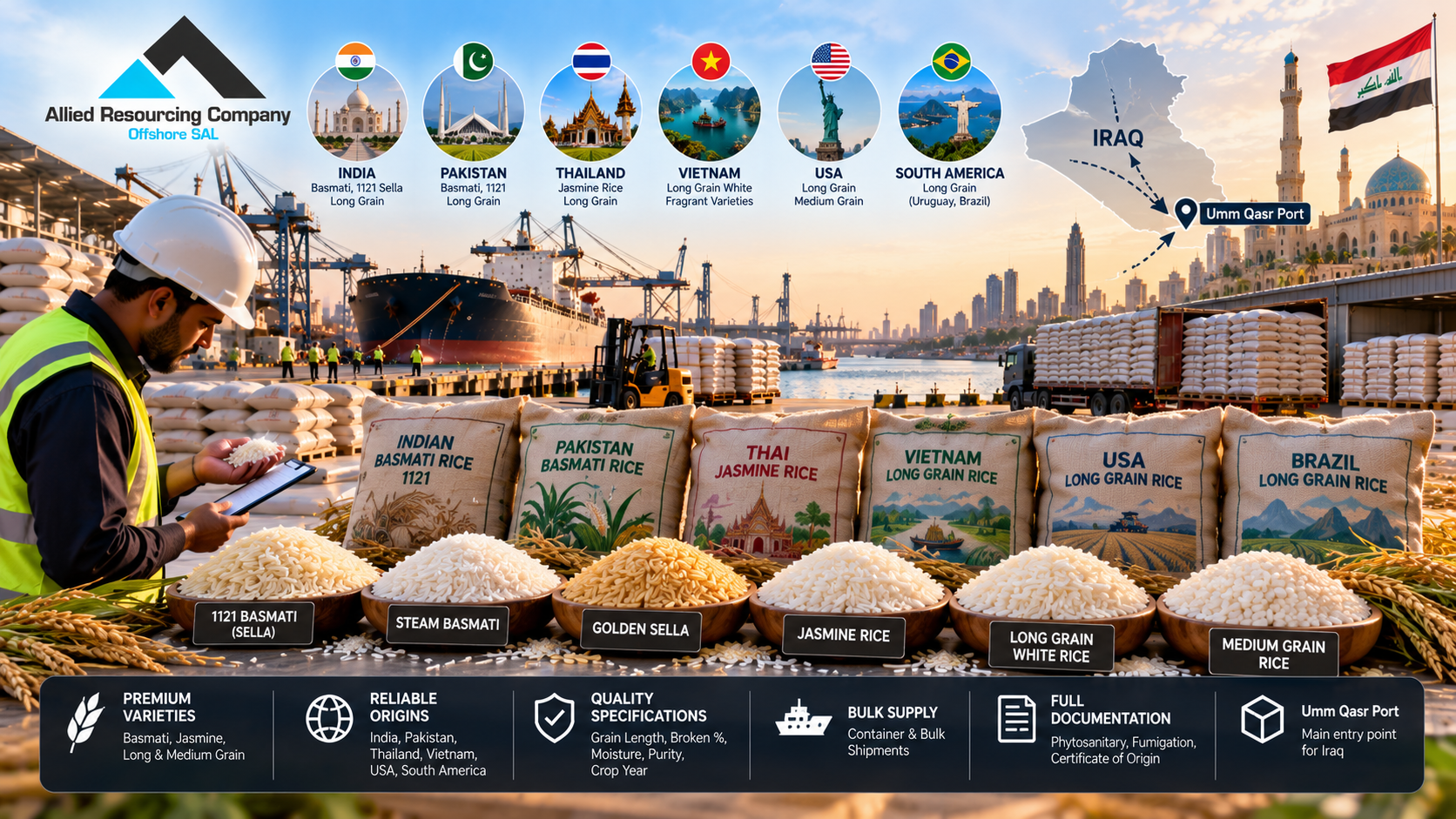
Walk through any wholesale market in Baghdad, Basra, Mosul or Erbil and rice is everywhere: stacked in printed sacks, sold by the bag and by the tonne, cooked into timman, biryani, quzi and dolma in homes and restaurants across the country. Iraq’s own rice production, including the prized aromatic Anbar rice, is small relative to demand. The gap is filled by imports, both through government procurement for the public food distribution system and through private wholesalers who supply retail and food service.
This guide is for those private rice wholesalers in Iraq. It is organised as a buyer’s journey: who you sell to, which variety fits, which origin supplies it, how to write the specification, how to pack it and how to get it home.
The most common mistake new rice importers make is starting with whatever is cheapest on the international market. Iraqi consumers are particular about rice. Grain length, cooking behaviour, aroma and how well the grains stay separate all matter. A cheaper rice that cooks sticky or breaks in the pot will sit in the warehouse.
Before contacting a supplier, answer three questions:
The 1121 basmati sella variety has become one of the most popular imported rices across Iraq and the Gulf. It is known for its exceptional grain length after cooking and for grains that remain separate. Parboiling, where paddy is soaked, steamed and dried before milling, makes the grain firmer and more forgiving in the pot. It comes in golden sella (deeper colour from longer steaming) and white sella (lighter colour).
Traditional basmati varieties offer stronger aroma. Steam basmati is lightly steamed for a firmer grain while keeping a whiter appearance than sella. These suit premium retail and restaurants.
Long grain white rice from India, Thailand, Vietnam, the United States and South America serves the value and mass market segments. It cooks quickly and is widely used in everyday meals.
Thai Hom Mali and other jasmine varieties are soft, fragrant and slightly sticky. They serve specific customers and Asian restaurants more than the mainstream Iraqi table.
Medium grain rice, including Calrose-type rice from the United States, has a following in parts of the Iraqi market and has featured in government procurement.
|
Origin |
Main Rice Types for Iraq |
Strengths |
Points to Check |
|
India |
1121 basmati sella, steam basmati, non-basmati long grain |
Wide range, competitive pricing, strong sella supply |
Export policy changes, consistency between mills |
|
Pakistan |
Basmati, 1121, long grain |
Aromatic basmati, established Middle East trade |
Crop quality by season, mill selection |
|
Thailand |
Jasmine, long grain white, parboiled |
Strong quality reputation |
Price usually higher than Vietnam |
|
Vietnam |
Long grain white, fragrant varieties |
Competitive pricing |
Specification consistency |
|
United States |
Long grain, medium grain |
Quality systems, consistent grading |
Freight cost and transit time |
|
South America (Uruguay, Brazil) |
Long grain |
Good quality, alternative supply |
Availability varies by season |
Origin decisions are not permanent. Export policies in major producing countries can change, sometimes with little warning, and price relationships between origins shift through the year. Wholesalers who can switch origins quickly protect both supply and margins. An experienced sourcing partner with mill relationships in several countries makes that flexibility practical.
A rice specification turns a variety name into something measurable. Without it, “1121 sella” can mean very different rice from different mills.
Crop year. The harvest year of the paddy. Aged basmati, held for a period after harvest, cooks better and commands higher prices. Specify the crop year and, for premium basmati, the minimum ageing.
Average grain length (AGL). Measured in millimetres before cooking. For 1121 basmati this is a key quality and price driver. Specify a minimum.
Broken grains. The percentage of grains broken during milling. Lower broken percentage means higher price and better appearance. Typical commercial grades range from 1% or 2% for premium rice to much higher levels for economy grades.
Moisture. Maximum moisture content, commonly around 14% or below for milled rice. High moisture increases the risk of mould and insect damage during transit.
Purity. The share of grains that belong to the stated variety. Mixing in cheaper varieties is a known risk in the basmati trade.
Chalky grains. Grains with an opaque white area. They affect appearance and cooking quality.
Damaged and discoloured grains. Grains affected by heat, insects or moisture. Specify maximum limits.
Foreign matter. Stones, husk and other material. Sortex cleaned rice, sorted by optical machines, should have very low foreign matter.
Processing type. Raw, steam, white sella or golden sella. Each cooks and looks different, so it must be stated.
Agree who tests, where and when. An independent inspection company sampling at loading gives an objective reference. For large or new contracts, testing again on arrival protects the buyer.
Packaging is a sales decision as much as a logistics one. Iraqi wholesalers commonly use:
If you are building your own brand, agree the artwork, the Arabic text and the labelling content with the mill well in advance. Printed bags have lead times, and mistakes on thousands of sacks are expensive to fix.
Label content typically includes product name, variety, origin, net weight, production and expiry dates, packer details and storage instructions, with Arabic text for the Iraqi market.
Most private wholesalers import rice in 20 foot containers, each carrying roughly 25 tonnes of bagged rice depending on bag size. Containers allow smaller, more frequent orders and keep branded bags protected. Large government tenders often move in bulk vessels or very large container programmes.
Umm Qasr port near Basra is the main entry point for rice imports into Iraq. From there, cargo moves by truck to warehouses in Basra, Baghdad and other cities. Wholesalers serving the Kurdistan Region may also receive cargo overland through neighbouring countries.
Rice is sensitive to moisture and heat. Long voyages and hot conditions can cause condensation inside containers, sometimes called container rain, which damages bags and grain. Good practice includes properly dried rice, moisture absorbers in the container, and fumigation before loading to control insects.
Rice demand in Iraq rises ahead of Ramadan and the Eid holidays, when families and restaurants cook larger meals. Because Ramadan moves earlier each year on the Gregorian calendar, wholesalers should plan orders backwards from the expected date, allowing for milling, packing, transit and clearance. Ordering early also lets you choose new crop or aged rice deliberately, rather than taking whatever stock a mill has left when the market is tight.
A typical private rice import into Iraq requires:
Iraq periodically reviews import permissions for agricultural products, sometimes to support local harvests. Requirements for rice can change, so confirm the current position with your customs broker before each new contract or origin.
The price per tonne on a supplier’s offer is only the starting point. Iraqi wholesalers should calculate:
Comparing suppliers on this full landed cost, not just the headline price, gives a much more accurate picture.
ARCOSAL supplies rice, wheat, sugar, edible oils and other agro commodities to wholesalers and distributors in Iraq and across the Middle East. We work with qualified mills in multiple origins, agree specifications in writing, arrange independent inspection, support private label packaging and coordinate documentation and logistics to Umm Qasr. Discover our sourcing and supply chain management approach or visit arcosalbe.com to request a quote.
Long grain basmati, especially 1121 basmati sella, is among the most popular imported rices, alongside long grain white rice for everyday use. Iraq’s local Anbar rice is highly valued but produced in limited quantities.
Mainly India and Pakistan for basmati, Thailand and Vietnam for jasmine and long grain white rice, and the United States and South America for long and medium grain rice.
It is a long grain basmati variety that has been parboiled before milling. Parboiling makes the grain firmer and helps it stay separate after cooking. It comes in golden sella and white sella forms.
Variety, crop year, average grain length, broken percentage, moisture, purity, chalky grains, damaged and discoloured grains, foreign matter, processing type and packaging.
Typically a commercial invoice, packing list, bill of lading, certificate of origin, phytosanitary certificate, fumigation certificate, quality inspection report and the conformity documentation required by Iraqi authorities.
Roughly 25 tonnes of bagged rice, depending on bag size and packing method.
Umm Qasr port near Basra is the main entry point, with some cargo for the Kurdistan Region arriving overland.
Yes. Many Iraqi wholesalers import rice in private label bags. Agree artwork, Arabic labelling and quantities with the mill early, as printed packaging has lead times.