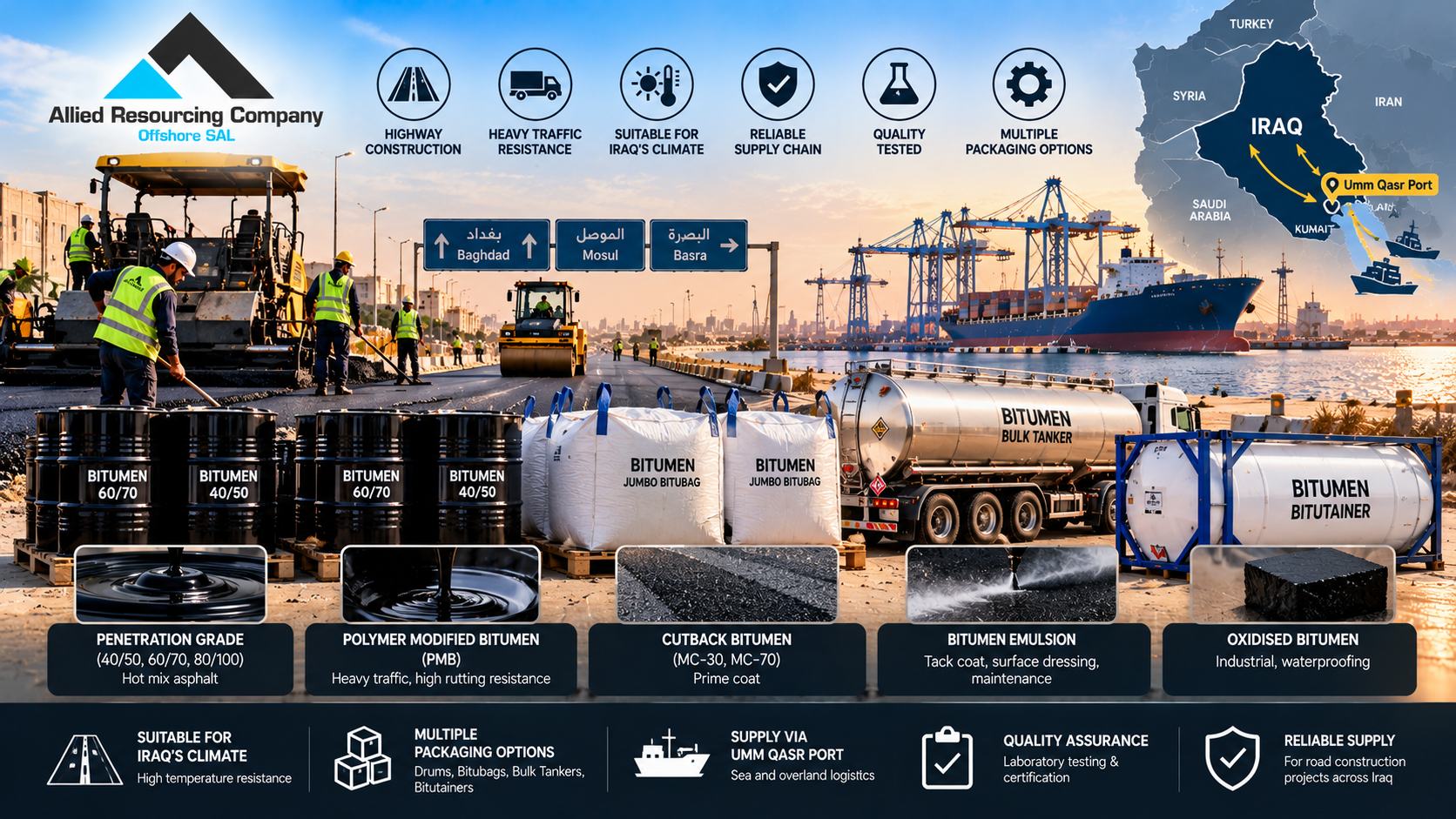
Iraq is rebuilding and expanding its road network. Highways connecting Basra, Baghdad, Mosul and the Kurdistan Region, ring roads around growing cities, rural roads linking agricultural areas and new routes tied to trade corridors all depend on one material more than any other: bitumen, the binder that holds asphalt together.
For contractors, a delay in bitumen supply can stop a paving crew, idle expensive equipment and push a project behind schedule. A wrong grade can mean early cracking or rutting that brings the road back for repairs within a few years. This article is written as a playbook for contractors, project managers and procurement teams responsible for bitumen supply in Iraq, covering the decisions they face from tender to paving.
Every road project has a technical specification, and the binder requirement sits inside it. In Iraq, projects commonly follow the General Specifications for Roads and Bridges issued by the State Corporation for Roads and Bridges, alongside each project’s own technical documents. International donor-funded or consultant-supervised projects may also reference ASTM, AASHTO or European standards.
Before requesting a single quote, confirm:
Suppliers can only quote accurately against a clear requirement. Contractors who send vague enquiries receive offers for whatever grade is easiest to supply, not necessarily what the project needs.
|
Bitumen Type |
Typical Grades |
Main Use in Iraqi Projects |
|
Penetration grade |
40/50, 60/70, 80/100 |
Hot mix asphalt for wearing and binder courses |
|
Performance grade (PG) |
High temperature grades such as PG 70 and PG 76 |
Highways and heavy traffic roads designed to Superpave principles |
|
Polymer modified bitumen (PMB) |
SBS modified grades |
Heavy traffic, junctions, bus lanes, high rutting risk sections |
|
Cutback bitumen |
MC-30, MC-70 |
Prime coat on granular bases |
|
Bitumen emulsion |
Cationic slow and rapid setting grades |
Tack coat, surface dressing, patching and maintenance |
|
Oxidised bitumen |
Industrial grades |
Waterproofing and roofing rather than paving |
Penetration grade bitumen is classified by how far a standard needle penetrates a sample at 25°C, in tenths of a millimetre. A 40/50 grade is harder than a 60/70, which is harder than an 80/100. Harder grades resist softening in high temperatures.
PG binders are specified by the temperature range in which they perform. The first number reflects the high pavement temperature the binder is designed to withstand. For Iraq’s climate, high temperature grades are typically required for major roads.
Adding polymers such as SBS improves elasticity and resistance to rutting and cracking. PMB costs more, but on heavily loaded sections it can extend pavement life significantly. It also requires careful handling and storage to prevent separation.
Iraq’s climate is one of the toughest in the world for asphalt. Summer air temperatures regularly exceed 45°C, and pavement surface temperatures climb far higher. At the same time, heavily loaded trucks carrying goods and construction materials travel the main corridors.
Hot pavement plus heavy axles is the classic recipe for rutting, the deformation that forms grooves in the wheel paths. Soft binders that perform well in cooler countries can fail quickly here. That is why harder penetration grades, high temperature PG binders and polymer modification are common choices for Iraqi highways.
Winters in the north, including parts of the Kurdistan Region, can be cold, so binder selection for those areas also needs to consider low temperature cracking. A single grade does not suit every part of the country.
Packaging decides how bitumen is handled on site, how much it costs to move, and how much is wasted.
|
Format |
How It Works |
Best For |
Watch Out For |
|
Steel drums |
Bitumen filled hot into new steel drums, typically holding around 150 to 180 kg |
Smaller projects, remote sites, long storage |
Drum cutting and heating on site, residue left in drums |
|
Jumbo bitubags |
Polypropylene bags holding around one tonne, melted on site |
Medium projects, efficient handling |
Requires suitable melting equipment |
|
Bulk in heated tankers |
Hot liquid bitumen delivered by road tanker |
Large projects near terminals or refineries |
Requires heated storage on site |
|
Bitutainers |
Heated ISO tank containers |
Larger volumes shipped by sea |
Return logistics for the tanks |
For many Iraqi contractors, drums and bitubags remain popular because they can be stored for long periods and transported to sites without heated tanks. Large highway projects with heated storage often prefer bulk supply to reduce handling cost and waste.
Iraq’s refineries produce bitumen, but supply can vary in volume, timing and consistency, particularly during periods of high construction demand. Many contractors therefore combine domestic supply with imports.
Imported bitumen reaches Iraq from refineries in the Gulf region and other producing countries in Asia and the Mediterranean. Umm Qasr port handles sea shipments of drums, bitubags and bitutainers. Overland routes through neighbouring countries also supply some projects, particularly in the north.
Bitumen origin matters legally as well as technically. International banks, insurers and shipping companies apply sanctions screening to petroleum products. Material from a sanctioned origin, or documents that disguise origin, can freeze payments, void insurance and expose the buyer to serious legal risk. Contractors should require clear certificates of origin and work only with suppliers who can demonstrate fully compliant supply chains. An experienced sourcing and supply chain partner adds real protection here.
Bitumen supply problems usually start with late planning. A practical timeline for an imported supply programme looks like this:
Eight to twelve weeks before paving. Confirm the grade and quantities with the design and quality teams. Issue enquiries to qualified suppliers with the full specification.
Six to eight weeks before. Select the supplier, agree the contract and payment terms, and request pre-shipment samples or certificates for the production lot.
Four to six weeks before. Production and packing. Independent inspection at loading confirms grade, quantity and packaging.
Two to four weeks before. Transit and port arrival. Customs clearance and inland transport to site or storage.
Paving period. Call off deliveries in line with the paving schedule, with a safety stock on site to protect against delays.
The paving season matters. Many contractors avoid laying asphalt in the peak of summer or in the wettest winter weeks, so demand for bitumen tends to concentrate in the spring and autumn. Planning ahead of these peaks avoids competing with every other contractor for the same supply.
Certificates from the supplier are a starting point, not the end of quality control. Contractors and supervising consultants typically test bitumen on arrival or before use. Key tests include:
For PG binders and PMB, additional rheological tests apply. Keep test records by lot, so any pavement performance issue can be traced back to the binder used.
Bitumen is a robust material, but poor handling causes real problems.
Bitumen is often priced with reference to regional market conditions and crude oil movements, so prices change over time. Contracts commonly use CFR or CIF Umm Qasr, delivered to site, or ex-works terms. Payment by documentary Letter of Credit, with an independent inspection certificate as a required document, protects contractors on quality and quantity. Price adjustment clauses are worth discussing for long projects with phased deliveries.
ARCOSAL supplies bitumen, EN590 diesel, fuel oil and other petroleum products to contractors and distributors across the Middle East and Africa. We source specified grades from qualified refineries, arrange independent inspection, prepare clear documentation and coordinate delivery in drums, bitubags or bulk to Umm Qasr and onward to project sites. Every supply chain we manage is built for full compliance. Learn more about our sourcing and supply chain management approach, or visit arcosalbe.com to discuss your project’s bitumen requirements.
Penetration grades such as 40/50 and 60/70 are widely used for hot mix asphalt, with high temperature PG binders and polymer modified bitumen used on heavily trafficked roads. The project specification determines the exact grade.
Iraq’s very high summer pavement temperatures and heavy truck traffic increase the risk of rutting. Harder and modified binders resist softening and deformation better.
The numbers refer to needle penetration at 25°C. 40/50 is harder than 60/70, giving better resistance to high temperatures, while 60/70 is slightly softer and more flexible.
In steel drums, one tonne jumbo bitubags, heated bulk road tankers or heated ISO bitutainers, depending on volume, site facilities and route.
Umm Qasr port near Basra handles sea shipments. Some supply also arrives overland through neighbouring countries.
Penetration, softening point, ductility, flash point, solubility, loss on heating or RTFOT, and specific gravity, with additional rheological tests for PG binders and PMB.
On heavy traffic sections, junctions, climbing lanes and other areas with high rutting risk, where longer pavement life outweighs the higher binder cost.
Banks, insurers and shipping lines apply sanctions screening to petroleum products. Unclear or non-compliant origin can block payments and create legal risk, so contractors should insist on verified certificates of origin.
Iraq is rebuilding and expanding its road network. Highways connecting Basra, Baghdad, Mosul and the Kurdistan Region, ring roads around growing cities, rural roads linking agricultural areas and new routes tied to trade corridors all depend on one material more than any other: bitumen, the binder that holds asphalt together.
For contractors, a delay in bitumen supply can stop a paving crew, idle expensive equipment and push a project behind schedule. A wrong grade can mean early cracking or rutting that brings the road back for repairs within a few years. This article is written as a playbook for contractors, project managers and procurement teams responsible for bitumen supply in Iraq, covering the decisions they face from tender to paving.
Every road project has a technical specification, and the binder requirement sits inside it. In Iraq, projects commonly follow the General Specifications for Roads and Bridges issued by the State Corporation for Roads and Bridges, alongside each project’s own technical documents. International donor-funded or consultant-supervised projects may also reference ASTM, AASHTO or European standards.
Before requesting a single quote, confirm:
Suppliers can only quote accurately against a clear requirement. Contractors who send vague enquiries receive offers for whatever grade is easiest to supply, not necessarily what the project needs.
|
Bitumen Type |
Typical Grades |
Main Use in Iraqi Projects |
|
Penetration grade |
40/50, 60/70, 80/100 |
Hot mix asphalt for wearing and binder courses |
|
Performance grade (PG) |
High temperature grades such as PG 70 and PG 76 |
Highways and heavy traffic roads designed to Superpave principles |
|
Polymer modified bitumen (PMB) |
SBS modified grades |
Heavy traffic, junctions, bus lanes, high rutting risk sections |
|
Cutback bitumen |
MC-30, MC-70 |
Prime coat on granular bases |
|
Bitumen emulsion |
Cationic slow and rapid setting grades |
Tack coat, surface dressing, patching and maintenance |
|
Oxidised bitumen |
Industrial grades |
Waterproofing and roofing rather than paving |
Penetration grade bitumen is classified by how far a standard needle penetrates a sample at 25°C, in tenths of a millimetre. A 40/50 grade is harder than a 60/70, which is harder than an 80/100. Harder grades resist softening in high temperatures.
PG binders are specified by the temperature range in which they perform. The first number reflects the high pavement temperature the binder is designed to withstand. For Iraq’s climate, high temperature grades are typically required for major roads.
Adding polymers such as SBS improves elasticity and resistance to rutting and cracking. PMB costs more, but on heavily loaded sections it can extend pavement life significantly. It also requires careful handling and storage to prevent separation.
Iraq’s climate is one of the toughest in the world for asphalt. Summer air temperatures regularly exceed 45°C, and pavement surface temperatures climb far higher. At the same time, heavily loaded trucks carrying goods and construction materials travel the main corridors.
Hot pavement plus heavy axles is the classic recipe for rutting, the deformation that forms grooves in the wheel paths. Soft binders that perform well in cooler countries can fail quickly here. That is why harder penetration grades, high temperature PG binders and polymer modification are common choices for Iraqi highways.
Winters in the north, including parts of the Kurdistan Region, can be cold, so binder selection for those areas also needs to consider low temperature cracking. A single grade does not suit every part of the country.
Packaging decides how bitumen is handled on site, how much it costs to move, and how much is wasted.
|
Format |
How It Works |
Best For |
Watch Out For |
|
Steel drums |
Bitumen filled hot into new steel drums, typically holding around 150 to 180 kg |
Smaller projects, remote sites, long storage |
Drum cutting and heating on site, residue left in drums |
|
Jumbo bitubags |
Polypropylene bags holding around one tonne, melted on site |
Medium projects, efficient handling |
Requires suitable melting equipment |
|
Bulk in heated tankers |
Hot liquid bitumen delivered by road tanker |
Large projects near terminals or refineries |
Requires heated storage on site |
|
Bitutainers |
Heated ISO tank containers |
Larger volumes shipped by sea |
Return logistics for the tanks |
For many Iraqi contractors, drums and bitubags remain popular because they can be stored for long periods and transported to sites without heated tanks. Large highway projects with heated storage often prefer bulk supply to reduce handling cost and waste.
Iraq’s refineries produce bitumen, but supply can vary in volume, timing and consistency, particularly during periods of high construction demand. Many contractors therefore combine domestic supply with imports.
Imported bitumen reaches Iraq from refineries in the Gulf region and other producing countries in Asia and the Mediterranean. Umm Qasr port handles sea shipments of drums, bitubags and bitutainers. Overland routes through neighbouring countries also supply some projects, particularly in the north.
Bitumen origin matters legally as well as technically. International banks, insurers and shipping companies apply sanctions screening to petroleum products. Material from a sanctioned origin, or documents that disguise origin, can freeze payments, void insurance and expose the buyer to serious legal risk. Contractors should require clear certificates of origin and work only with suppliers who can demonstrate fully compliant supply chains. An experienced sourcing and supply chain partner adds real protection here.
Bitumen supply problems usually start with late planning. A practical timeline for an imported supply programme looks like this:
Eight to twelve weeks before paving. Confirm the grade and quantities with the design and quality teams. Issue enquiries to qualified suppliers with the full specification.
Six to eight weeks before. Select the supplier, agree the contract and payment terms, and request pre-shipment samples or certificates for the production lot.
Four to six weeks before. Production and packing. Independent inspection at loading confirms grade, quantity and packaging.
Two to four weeks before. Transit and port arrival. Customs clearance and inland transport to site or storage.
Paving period. Call off deliveries in line with the paving schedule, with a safety stock on site to protect against delays.
The paving season matters. Many contractors avoid laying asphalt in the peak of summer or in the wettest winter weeks, so demand for bitumen tends to concentrate in the spring and autumn. Planning ahead of these peaks avoids competing with every other contractor for the same supply.
Certificates from the supplier are a starting point, not the end of quality control. Contractors and supervising consultants typically test bitumen on arrival or before use. Key tests include:
For PG binders and PMB, additional rheological tests apply. Keep test records by lot, so any pavement performance issue can be traced back to the binder used.
Bitumen is a robust material, but poor handling causes real problems.
Bitumen is often priced with reference to regional market conditions and crude oil movements, so prices change over time. Contracts commonly use CFR or CIF Umm Qasr, delivered to site, or ex-works terms. Payment by documentary Letter of Credit, with an independent inspection certificate as a required document, protects contractors on quality and quantity. Price adjustment clauses are worth discussing for long projects with phased deliveries.
ARCOSAL supplies bitumen, EN590 diesel, fuel oil and other petroleum products to contractors and distributors across the Middle East and Africa. We source specified grades from qualified refineries, arrange independent inspection, prepare clear documentation and coordinate delivery in drums, bitubags or bulk to Umm Qasr and onward to project sites. Every supply chain we manage is built for full compliance. Learn more about our sourcing and supply chain management approach, or visit arcosalbe.com to discuss your project’s bitumen requirements.
Penetration grades such as 40/50 and 60/70 are widely used for hot mix asphalt, with high temperature PG binders and polymer modified bitumen used on heavily trafficked roads. The project specification determines the exact grade.
Iraq’s very high summer pavement temperatures and heavy truck traffic increase the risk of rutting. Harder and modified binders resist softening and deformation better.
The numbers refer to needle penetration at 25°C. 40/50 is harde r than 60/70, giving better resistance to high temperatures, while 60/70 is slightly softer and more flexible.
In steel drums, one tonne jumbo bitubags, heated bulk road tankers or heated ISO bitutainers, depending on volume, site facilities and route.
Umm Qasr port near Basra handles sea shipments. Some supply also arrives overland through neighbouring countries.
Penetration, softening point, ductility, flash point, solubility, loss on heating or RTFOT, and specific gravity, with additional rheological tests for PG binders and PMB.
On heavy traffic sections, junctions, climbing lanes and other areas with high rutting risk, where longer pavement life outweighs the higher binder cost.
Banks, insurers and shipping lines apply sanctions screening to petroleum products. Unclear or non-compliant origin can block payments and create legal risk, so contractors should insist on verified certificates of origin.